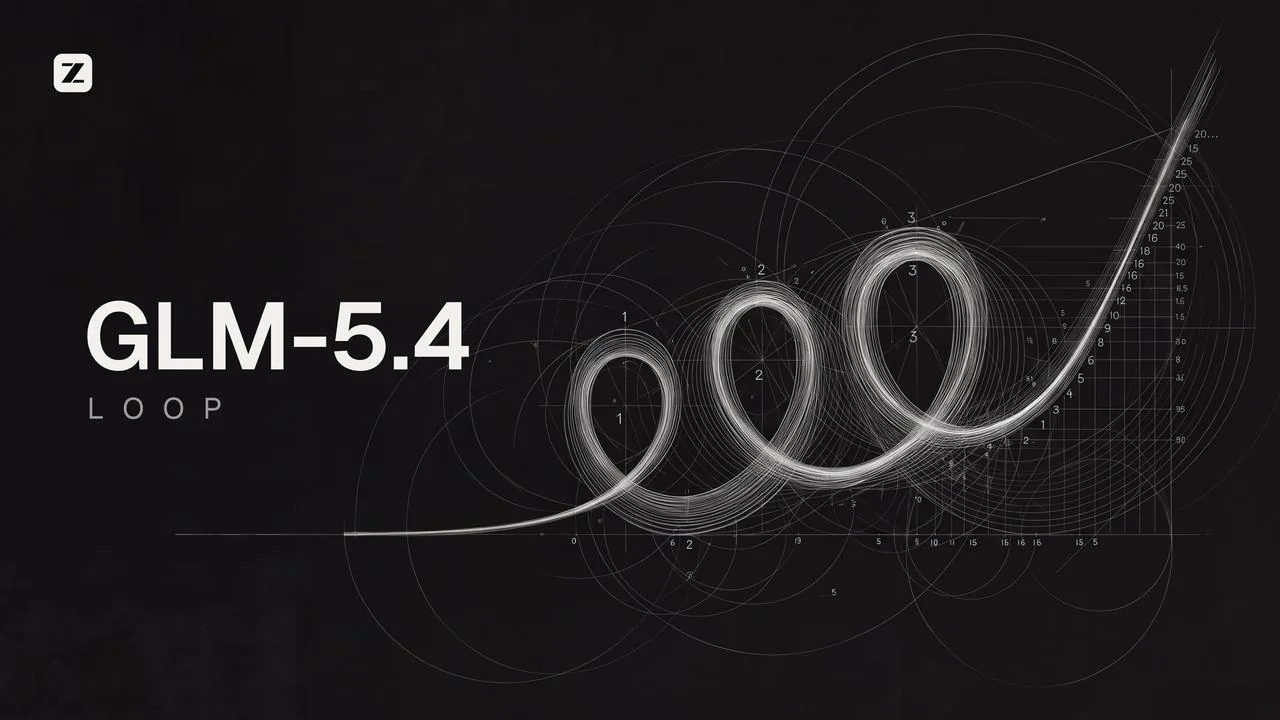
Z.ai Launches GLM-5.4: First 750B-Scale Loop Transformer Flagship Built for Generalized Coding
Debuting on November 23 across Z.ai’s GLM Coding Plan with 1.5x weekly quota, GLM-5.4 loops 28 layers of its ~750B GLM-5 base across two passes inside a 1M multimodal context—targeting Generalized Coding while standalone Model API and open weights await security assessment.
THE STORY IN THREE POINTS
- First Loop Transformer flagship: Z.ai adapted its ~750B GLM-5 pre-trained base through continued training so 28 shared middle layers execute across two iterations using Gated Progressive Updates, a Hybrid KV Cache, and Sparse Attention Index Reuse—claiming intelligence comparable to 2T–3T parameter models across 1M context and 128K max output.
- In Z.ai’s internal head-to-head Win Rate charts, GLM-5.4 posts 51.1% wins vs GLM-5.3 (25.7% ties / 23.1% losses), 41.8% vs Kimi K3.1 Pro (26.9% ties / 31.3% losses), and 36.6% vs DeepSeek-V4.1-Flash-1017 (30.2% ties / 33.2% losses), while 30B iso-parameter ablations (+10% compute) lift AIME25 +11.3 points (19.17 to 30.42) and GPQA-Diamond +8.7 (47.58 to 56.26) alongside 10–14% shorter CoT length—though Z.ai cautions GLM-5.4 can enter overly long "marathon thinking" loops.
- Immediate availability is scoped to GLM Coding Plan subscribers (plans starting at $18/month spanning ZCode, Claude Code, Codex, OpenCode, and OpenClaw with weekly quota boosted to 1.5x GLM-5.3), streaming at up to 200 tokens/s off-peak and 70–80 tokens/s at peak load—while standalone Model API access and downloadable open weights remain held pending Z.ai’s security assessment.
Adapting a 750B GLM-5 base into a two-iteration Loop Transformer
In Z.ai’s November 23 announcement and official GLM-5.4 developer documentation, Zhipu AI frames computational depth—rather than raw parameter growth alone—as the limiting constraint for long-horizon reasoning across software systems, cybersecurity, 3D modeling, and physical control. Rather than training a weight-shared Universal Transformer from scratch, Z.ai applied continued training to convert its ~750B GLM-5 base checkpoint so 28 shared middle layers execute twice per forward pass.
Scaling recursion to 750B required three architectural modifications documented by Z.ai: Gated Progressive Updates introducing per-token gates so pass one writes global context conservatively without activation-norm blowups before pass two opens gates proportionally; a Hybrid KV Cache pairing cross-loop sparse KV sharing with an independent sliding window so an extra loop costs only one sliding window instead of doubling 1M-context memory; and Sparse Attention Index Reuse carrying pass-one indices straight into pass two with zero re-indexing cost.
Official Win Rate results, 30B Loop ablations, and "marathon thinking" trade-offs
Because Z.ai has not yet posted independent third-party leaderboard placements at launch, current performance evidence comes directly from the lab’s official evaluations. On Z.ai’s published GLM-5.4 Win Rate chart, GLM-5.4 scores 51.1% wins (25.7% ties, 23.1% losses) against predecessor GLM-5.3, 41.8% wins (26.9% ties, 31.3% losses) against Kimi K3.1 Pro, and 36.6% wins (30.2% ties, 33.2% losses) against DeepSeek-V4.1-Flash-1017.
In a controlled iso-parameter ablation validated on a 30B model sharing the 750B base topology after 200K SFT (~10% more training compute, Thinking Mode enabled), Z.ai reported gains across AIME25 (19.17 to 30.42, +11.3 points, -2% length), GPQA-Diamond (47.58 to 56.26, +8.7, -11.7% / -2,473 tokens), AA-LCR (40.33 to 47.67, +7.3, -9.7%), MMLU-Pro (71.65 to 75.05, +3.4, -14.9%), and IFBench (50.20 to 53.47, +3.3, -13.0%)—shifting part of reasoning from explicit CoT tokens into implicit loop depth. Co-designed fused inference kernels reach up to 200 tokens/s off-peak and 70–80 tokens/s at peak load, though Z.ai notes candidly that GLM-5.4 can get stuck in overly long "marathon thinking" reflection loops.
Generalized Coding: 1M multimodal context across video, FreeCAD robotics, and 3D shaders
Paired with native visual understanding, GLM-5.4 ships with Video, Image, Text, and File inputs, text output, a 1-million-token context window, up to 128K output tokens, Thinking Mode, real-time Streaming Messages, Function Calling, Context Caching, and JSON Structured Output.
Z.ai labels this expansion Generalized Coding—applying code as an underlying executable medium beyond conventional software repositories. Official showcase demos include coding and self-narrating the "Hello World" music video, constructing a 6-axis robotic arm inside FreeCAD mechanical engineering CAD workflows, and generating an interactive 3D macro bird-watching scene from pure mathematical geometry and custom GLSL shaders.
GLM Coding Plan goes live with 1.5x quota while Model API and open weights await review
GLM-5.4 is immediately usable for all GLM Coding Plan subscribers (Personal and Team subscriptions starting at $18/month supporting over 20 tools including ZCode, Claude Code, Codex, Cline, OpenCode, AutoClaw, and OpenClaw), with weekly quota allocations temporarily raised to 1.5x that of GLM-5.3.
In contrast to Z.ai’s open-weight releases covered in our GLM-5.3 vs GLM-5.3-Flash breakdown, open-weight licensing analysis, and AutoGLM coverage, Z.ai confirmed on November 23 that general pay-as-you-go Model API endpoints remain held back pending completion of a security assessment, and Hugging Face zai-org repositories do not yet host downloadable GLM-5.4 weights. Looking ahead, Z.ai says its next, significantly larger model will scale both physical parameter count and adaptive per-token loop iterations.
Sources: GLM-5.4 Official Technical Documentation|Z.ai Developer Docs ↗ GLM-5.4 Launch Blog Post|Z.ai ↗ GLM Coding Plan Supported Models & Quotas|Z.ai Developer Docs ↗ Z.ai (zai-org) Official Model Repository|Hugging Face ↗
THE BROADER CONTEXT · FRONTIER LABS DOSSIER
Explore full product specifications, pricing analysis, and continuous coverage in the Frontier Labs Desk Hub and GLM Dossier. Independent benchmarks available on the AI Intelligence Index and Coding Agents Leaderboard.