GLM-5.3 vs GLM-5.3-Flash: Pricing, Mandatory Reasoning, Benchmarks, and MIT vs Custom License Split
Side-by-side operational guide comparing Z.ai’s $1.40/$4.40 agentic flagship against its multimodal MIT-licensed $0.15/$0.50 Flash sibling across Terminal-Bench, CyberGym, and MaaS commercial rules.
THE STORY IN THREE POINTS
- Z.ai prices text-only GLM-5.3 (1M context / 128K max output) at $1.40 input, $0.26 cached input, and $4.40 output per 1M tokens with mandatory always-on thinking.type="enabled" (low/high/max, default max; passing disabled fails), whereas multimodal GLM-5.3-Flash drops to $0.15 input, $0.03 cached, and $0.50 output (FlashX $0.37/$1.25).
- Architectural divergence explains the cost spread: GLM-5.3-Flash pairs a 320B-total / 18B-active MoE backbone with sparse-plus-linear attention and manifold-constrained Hyper-Connections (mHC), cutting compute 3.01x and KV-cache footprint 4.44x relative to GLM-5.3.
- Open-weight licensing is split across the two repositories: zai-org/GLM-5.3 carries the bespoke GLM-5.3 License requiring prior Z.ai security review for MaaS operators above $10B trailing-12-month group revenue, while zai-org/GLM-5.3-Flash is pure MIT.
9.3x input price gap and GLM-5.3’s always-on thinking parameter
Teams deploying Z.ai’s latest generation face two sharply different engineering profiles masked by shared numbering. On the official Z.ai rate card, flagship GLM-5.3 is text-only with a 1M-token context window (128K max output) billed at $1.40 per million input tokens, $0.26 for cached input reads, and $4.40 per million output tokens. By contrast, GLM-5.3-Flash adds native vision-language multimodality at $0.15 input, $0.03 cached input, and $0.50 output (roughly 9x cheaper on uncached prompts), alongside a higher-speed GLM-5.3-FlashX API endpoint at $0.37 input and $1.25 output.
Latency budgets also differ structurally because GLM-5.3 enforces mandatory reasoning tokens on every call: API requests require thinking.type: "enabled" across low, high, or default max reasoning levels, and explicitly reject "disabled" with a validation error. Applications migrating from legal or classification templates or AutoGLM UI loops that need zero-thinking sub-second responses must target GLM-5.3-Flash instead, which leverages a 320B-total / 18B-active sparse-plus-linear attention design with manifold-constrained Hyper-Connections (mHC) to reduce compute by 3.01x and KV cache usage by 4.44x.
Benchmarks compared: Z.ai self-reports vs Artificial Analysis and Snorkel TB 4.1
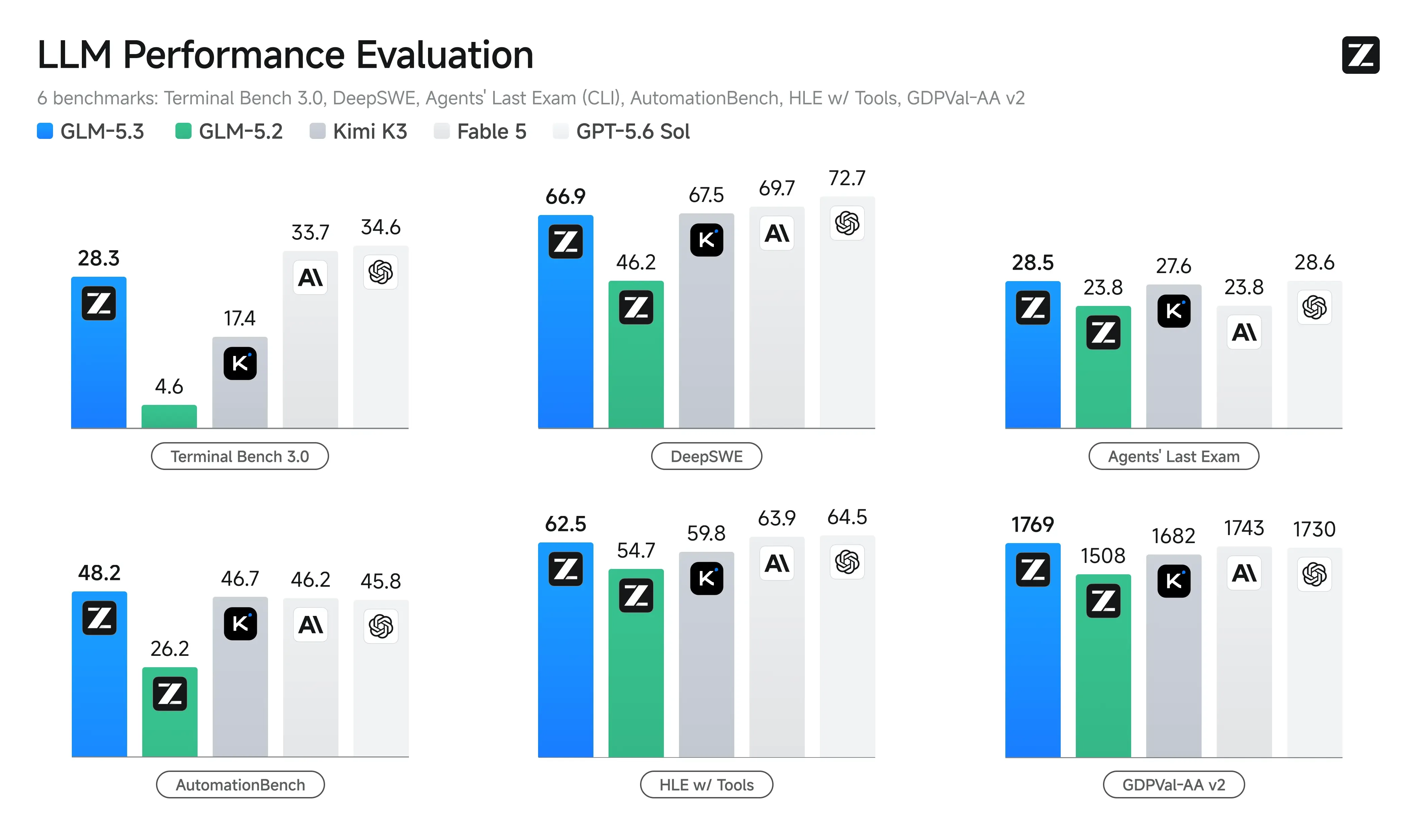
Z.ai’s flagship evaluation tables highlight offensive security and coding harness milestones for GLM-5.3, led by vendor-reported scores of 88.2 on Terminal-Bench 2.1, 28.3 on Terminal-Bench 3.0, 84.5 on CyberGym, and 54.4 on ExploitBench. Those internal numbers reinforce Z.ai’s positioning of GLM-5.3 as a dedicated software-security and long-horizon bash agent rather than a general consumer chat endpoint.
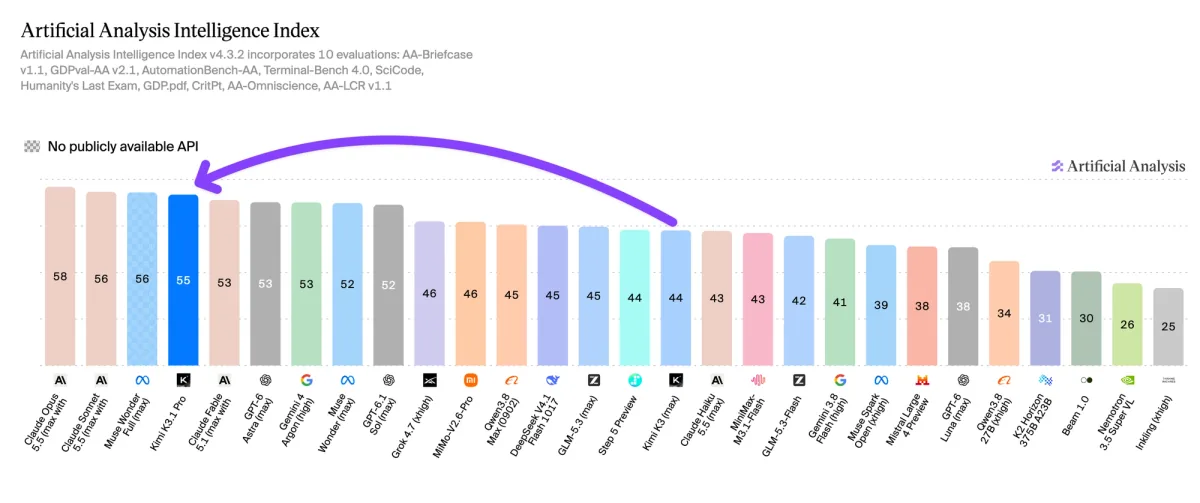
Independent evaluations place the flagship more conservatively in frontier rankings: Artificial Analysis records a GDPval-AA v2 Elo of 1769 (#49 on the Intelligence Index at score 32 on Max), while our coverage of Snorkel’s Terminal-Bench 4.1 leaderboard logs GLM-5.3 (max) paired with Claude Code at 41.2% (±3.3%), 12th overall across 330 verifier-hardened trials at a $2.7k total run expenditure.
License compliance trap: Why GLM-5.3 is not MIT even though Flash is
Perhaps the most consequential detail missed by third-party aggregators is that the two models do not share an open-source license. Inspection of Hugging Face model repositories shows that zai-org/GLM-5.3-Flash distributes under standard permissive MIT terms, allowing unrestricted self-hosting, distillation-compatible research within MIT bounds, and commercial cloud serving.
zai-org/GLM-5.3, however, carries a custom GLM-5.3 License. While permissive for most developers and startups, its terms stipulate that commercial Model-as-a-Service (MaaS) providers whose corporate group earned more than $10 billion in trailing-12-month revenue must complete a prior security review with Z.ai before offering hosted API inference—placing GLM-5.3 alongside conditional hyperscaler clauses analyzed in our open-weight licensing compliance matrix.
Sources: Z.ai API Pricing & Rate Card (GLM-5.3 & GLM-5.3-Flash)|Z.ai Docs ↗ GLM-5.3 Model Documentation & Mandatory Thinking Controls|Z.ai Docs ↗ GLM-5.3-Flash Vision-Language Model Guide|Z.ai Docs ↗ zai-org/GLM-5.3 Weights & GLM-5.3 License|Hugging Face ↗ zai-org/GLM-5.3-Flash Weights & MIT License|Hugging Face ↗ GLM-5.3 Independent Evaluation Metrics|Artificial Analysis ↗
THE BROADER CONTEXT · FRONTIER LABS DOSSIER
Explore full product specifications, pricing analysis, and continuous coverage in the Frontier Labs Desk Hub and GLM Dossier. Independent benchmarks available on the AI Intelligence Index and Coding Agents Leaderboard.