Ripple-65B Preview: Dense Architecture, Open Weights and Benchmarks
Ricursive Intelligence releases Ripple-65B Preview under Apache 2.0, pairing a dense 65B parameter architecture with a 1M context window and vendor-reported coding benchmarks.
THE STORY IN THREE POINTS
- Ricursive Intelligence released Ripple-65B Preview on November 4, 2026, publishing dense model weights under an ungated Apache 2.0 license on Hugging Face across BF16 Instruct, Base, and NVFP4 formats.
- The architecture incorporates 80 dense transformer layers, sliding window attention, a 1M context specification in model documentation, and a 2Mi max position embedding in configuration.
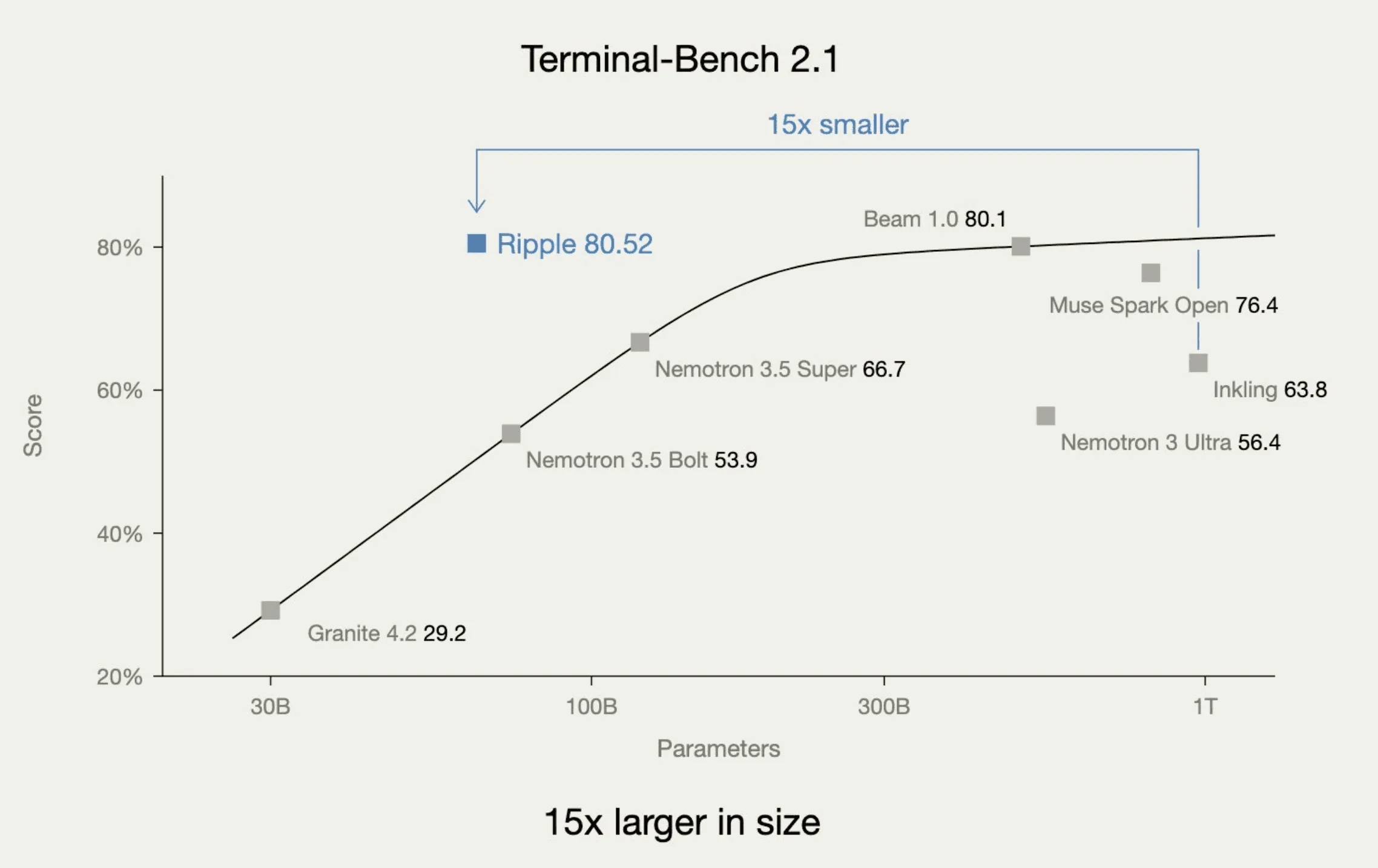
- Ricursive self-reports an 80.52 score on Terminal-Bench 2.1 using the default OpenCode harness; official Terminal-Bench 4.1 leaderboard rankings remain unconfirmed, and under unquantized BF16 weights and full KV cache without offloading, 1M context is estimated to exceed dual 80GB memory capacity.
Architecture and distribution: Ricursive Ripple 65B open weights release
In an open-source landscape increasingly dominated by sparse Mixture-of-Experts models, Ricursive Intelligence released Ripple 65B preview (designated Ripple-65B Preview) on November 4, 2026. Distributed under an ungated Apache 2.0 license, Ripple-65B open weights are available on Hugging Face across three checkpoint formats: BF16 Instruct (~130 GB across safetensors shards), Base foundation weights, and an NVFP4 quantized variant. Cloud inference is also hosted on platforms like OpenRouter, though physical weight downloads are served directly via Hugging Face.
The technical specification of the Ricursive Ripple 65B dense architecture incorporates 80 transformer layers, a hidden dimension of 5120, Grouped Query Attention (80 query heads and 8 key-value heads), and a head dimension of 128. While model documentation specifies a native 1-million-token context window trained across 12 trillion tokens, the model configuration file registers a maximum position embedding of 2,097,152 tokens (2Mi); developers should treat the 2Mi figure as a configuration ceiling rather than a verified production context window.
Hardware planning: Evaluating Ripple 65B VRAM requirements and context scaling
Infrastructure teams planning deployment must evaluate Ripple 65B VRAM requirements with realistic memory calculations. Loading the unquantized BF16 model parameters requires approximately 130 GB of VRAM before allocating memory for inference activation buffers or key-value caches. While quantized formats reduce initial model weight footprint, scaling toward million-token contexts expands memory requirements dramatically.
At extended context lengths, KV cache memory scales linearly with sequence length. Under a theoretical calculation for 16 full-attention layers with 8 key-value heads of dimension 128 in uncompressed BF16 precision (16 layers × 2 × 8 heads × 128 dim × 2 bytes × 1,000,000 tokens), a 1-million-token cache requires exactly 65,536,000,000 bytes (65.536 GB, or approximately 61.0 GiB). Combining this estimated KV footprint with roughly 130 GB of BF16 parameters totals approximately 195.5 GB—before accounting for runtime activations, framework overhead, or system buffers. This is an illustrative unquantized baseline rather than an empirical benchmark: while it shows that an uncompressed, non-offloaded BF16 setup exceeds dual 80GB accelerators, production deployments employing KV quantization, paged memory management, or CPU offloading may alter actual hardware feasibility.
Auditing benchmark claims: Examining the Ripple 65B benchmark self-reports
Community discussion has focused heavily on Ricursive’s headline Ripple 65B benchmark claim: a score of 80.52 on terminal coding tasks. Official model disclosures clarify that this 80.52 figure was evaluated in-house using the default OpenCode harness under Terminal-Bench 2.1 evaluation criteria. Ricursive notes that Terminus 2 evaluations at 128K context recorded lower scores, and an audit of the independent Terminal-Bench 4.1 leaderboard shows that Ripple-65B was not listed among verified top-13 entries at check time.
Practitioners examining Ripple-65B on Hugging Face and reviewing official Ripple examples in model documentation should treat self-reported figures as preliminary vendor measurements. While the Apache 2.0 release delivers valuable dense weights for coding agent research, developers should evaluate models against independent benchmarks, as discussed in our comparative guides on open weights licensing and computer use agents.
Sources: Ripple-65B Preview Announcement & Architecture Overview|Ricursive Intelligence ↗ Ripple-65B-Preview Checkpoints & Configuration|Hugging Face ↗ Ripple-65B Preview Inference Endpoints & Specs|OpenRouter ↗
THE BROADER CONTEXT · FRONTIER LABS DOSSIER
Explore full product specifications, pricing analysis, and continuous coverage in the Frontier Labs Desk Hub and Others Dossier. Independent benchmarks available on the AI Intelligence Index and Coding Agents Leaderboard.