Open Weights vs Open Source: Model Licenses and Commercial Use
A legal and technical guide examining open weights vs open source AI, clarifying the OSI definition, commercial use covenants, and practical licensing realities across frontier checkpoints.
THE STORY IN THREE POINTS
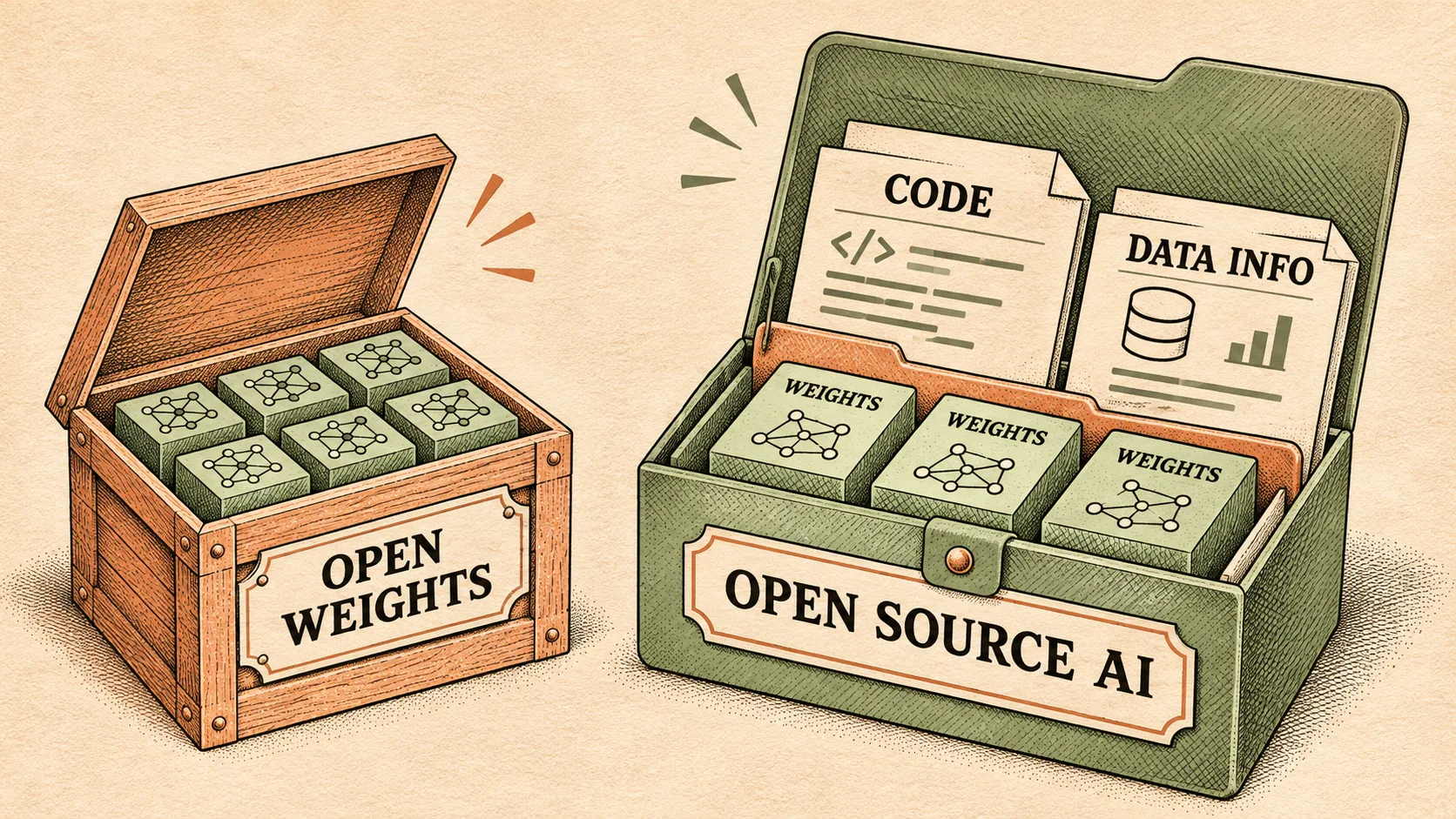
- The Open Source Initiative published the Open Source AI Definition 1.0 on October 28, 2024, establishing that open source AI requires data information, training code, and model parameters.
- Open weights releases provide downloadable parameters under licenses like MIT or Apache-2.0, but without training code or detailed data information, they differ from full open source AI.
- Commercial adopters must evaluate licenses individually: Meituan LongCat 2.5 uses MIT weights, Ricursive Ripple-65B uses Apache-2.0, and NVIDIA Lyra 2.0 pairs Apache-2.0 code with a restricted research weights license.
Legal definitions: Understanding open weights vs open source and OSI open source AI
The distinction between open weights vs open source AI was formalized on October 28, 2024, when the Open Source Initiative (OSI) officially announced the Open Source AI Definition 1.0 (OSAID 1.0). For years, technology organizations applied the label "open source" to downloadable neural network checkpoints. However, the OSI standard establishes that an open weights definition differs fundamentally from open source AI, and an open weights AI distribution cannot be assumed to satisfy open-source criteria.
Under the OSI open source AI standard, a system must provide the "preferred form to make modifications," which requires three distinct elements under OSI-approved terms: (1) Data Information, providing sufficiently detailed documentation about training data so a skilled practitioner could build an equivalent system, (2) Code, comprising the complete source code used to train and run the system, and (3) Parameters, providing the model weights. When an organization publishes model weights without training code or data information, the resulting artifact is an open weights model rather than a complete open source AI system under OSAID 1.0, even though accompanying code components may independently qualify as open source software.
MIT, Apache 2.0 and commercial use
Evaluating open weights commercial use requires examining specific license grants and reservations. A common assumption is that downloading weights under an open-source license grants unconditional freedom. In practice, open weights licensing varies widely across frontier models, and developers examining open weights vs open source models must inspect terms individually:
For example, Meituan published LongCat 2.5 open weights under the MIT License, which permits commercial use but explicitly retains Meituan trademarks and patents without publishing training code. Ricursive Intelligence released Ripple-65B dense weights under Apache-2.0 with inference scripts, yet training data remains unreleased. Most starkly, NVIDIA’s Lyra 2.0 releases source code under Apache-2.0, while model weights are governed by the NVIDIA Internal Scientific Research and Development Model License, strictly prohibiting commercial deployment, distribution, or production use.
Compliance checklist: Managing open weights compliance in production services
Navigating open weights compliance requires enterprise legal and engineering teams to audit five essential dimensions before deployment: the weights license, the code license, available data information, repository gating requirements, and commercial or acceptable use restrictions. Conditional releases, such as Thinking Machines’ Inkling 2 Small open weights roadmap, currently restrict access to Tinker Terms of Use while open weights await safety sign-off.
Teams must also verify whether licenses include commercial revenue thresholds, monthly active user limits, or restrictions against using model outputs to train competing systems. By distinguishing open weights from complete open source AI systems, organizations can better identify applicable license conditions, operational boundaries, and remaining legal questions before integrating downloadable models into production services.
Sources: The Open Source AI Definition 1.0 Announcement & Standard|Open Source Initiative ↗ Open Source Initiative: Open Weights Overview & FAQ|Open Source Initiative ↗ LongCat-2.5 Permissive MIT Open Weights Repository|Hugging Face ↗ Ripple-65B Ungated Apache 2.0 Open Weights Release|Hugging Face ↗ NVIDIA Lyra 2.0 Apache-2.0 Code & Research License Specification|GitHub ↗
THE BROADER CONTEXT · FRONTIER LABS DOSSIER
Explore full product specifications, pricing analysis, and continuous coverage in the Frontier Labs Desk Hub and Others Dossier. Independent benchmarks available on the AI Intelligence Index and Coding Agents Leaderboard.