Inkling 2 Small Open Weights Tracker: Tinker Pricing, Red-Team Conditions, and NVIDIA Cosmos 3 Contrast
Thinking Machines Lab deploys Inkling 2 Small on Tinker with $1.18 benchmark task costs, conditioning Apache 2.0 weights on red-teaming as NVIDIA releases Cosmos 3 Nano checkpoints.
THE STORY IN THREE POINTS
- Inkling 2 Small (594B total parameters / 17B active MoE) is live for inference on Tinker at $0.30/1M input and $1.00/1M output, while Apache 2.0 weights remain pending external red-team completion.
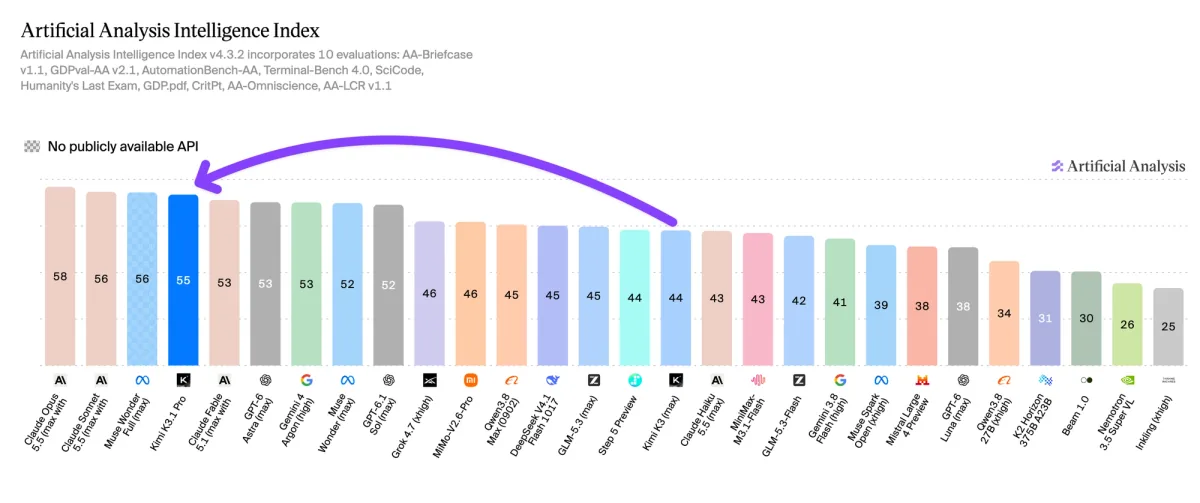
- Artificial Analysis benchmarks show Inkling 2 Small scores 31 with a task cost of $1.18, consuming ~150,000 output tokens per complex problem.
- In contrast to conditional releases, NVIDIA published four immediately downloadable 16B Cosmos 3 Nano post-training checkpoints under the permissive OpenMDW 1.1 license.
Live cloud inference versus conditional Apache 2.0 open weights
Thinking Machines Lab announced Inkling 2 Small, a massive sparse mixture-of-experts model comprising 594 billion total parameters with 17 billion parameters activated per token. While industry aggregators prematurely reported the model as fully open source, the physical weights are not yet publicly downloadable on Hugging Face.
Inkling 2 Small is currently live exclusively on the Tinker cloud platform, offering developer inference, sampling, and fine-tuning at $0.30 per million input tokens, $1.00 per million output tokens, and $0.03 for cached inputs. The lab stated that an Apache 2.0 open-weight release is slated for mid-November, conditioned explicitly on the successful completion of external red-teaming evaluations under its safe path governance framework.
Auditing benchmark scores, token volume and task economics
Initial evaluations conducted by Artificial Analysis award Inkling 2 Small an overall Intelligence Index rating of 31. Crucially, the benchmark data reveals that achieving frontier reasoning requires extensive speculative chain-of-thought expansion, averaging approximately 150,000 output tokens per solved benchmark problem.
This high token throughput results in an average cost of $1.18 per completed task. While substantially cheaper than proprietary enterprise reasoning models like Gemini 3.8 Flash ($7.77) or Claude Sonnet 5.5 ($10.02), it represents an approximate sixfold increase in token expenditure compared to Inkling’s first-generation checkpoints.
Contrasting conditional releases with NVIDIA’s Cosmos 3 drop
The deferred open-weight status of Inkling 2 Small highlights differing release strategies among frontier labs. On the same day, NVIDIA delivered immediate open access to four Cosmos 3 Nano post-training checkpoints, publishing 16-billion-parameter hybrid reasoning-and-generation weights directly to Hugging Face under the OpenMDW 1.1 license.
While NVIDIA’s Cosmos 3 ecosystem targets high-speed physical simulation and video synthesis across local workstation hardware, Thinking Machines’ deliberate staging reflects tightening oversight around large-parameter open-weight models with autonomous cyber capabilities.
Sources: Inkling 2 Small Architecture, Pricing & Safe Open Weights Path|Thinking Machines Lab ↗ NVIDIA Cosmos 3 Checkpoints & Model Card Documentation|Hugging Face ↗
THE BROADER CONTEXT · FRONTIER LABS DOSSIER
Explore full product specifications, pricing analysis, and continuous coverage in the Frontier Labs Desk Hub and Others Dossier. Independent benchmarks available on the AI Intelligence Index and Coding Agents Leaderboard.