Best GPU for Local LLM: VRAM, Bandwidth & Consumer Picks
For single-user local LLM inference, memory bandwidth—not raw compute FLOPS—dictates token generation speed once weights fit in VRAM. Here is how NVIDIA RTX 5070 Ti (896 GB/s), RTX 4090 (24 GB), RTX 5090 (1,792 GB/s), and 128 GB+ unified systems rank.
THE STORY IN THREE POINTS
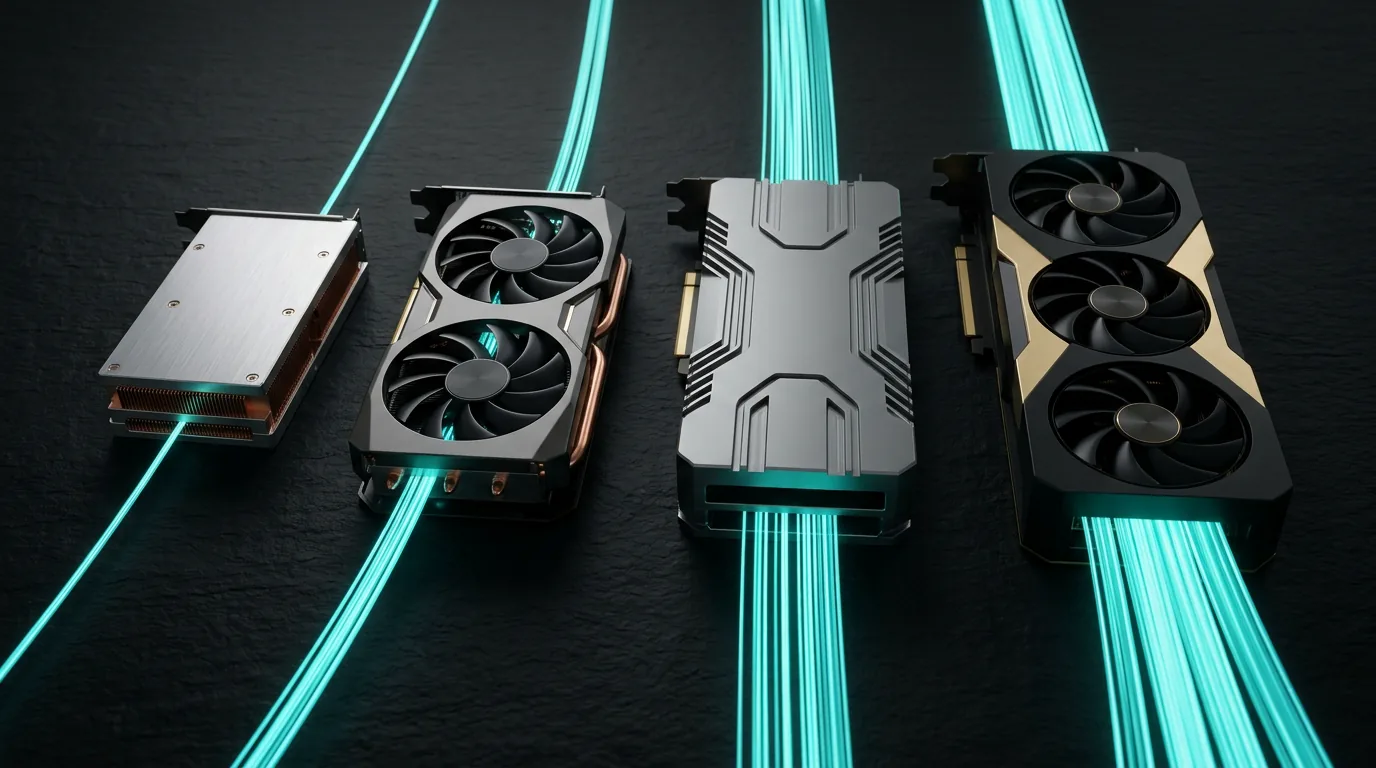
- Memory bandwidth drives local tok/s: autoregressive decoding reads nearly the entire model from VRAM for every generated token, meaning GB/s bandwidth and VRAM capacity decide real-world speed far more than TFLOPS.
- 16 GB vs 24 GB sweet spots: the $749 RTX 5070 Ti delivers 896 GB/s GDDR7 bandwidth (93% of the $999 RTX 5080’s 960 GB/s at 75% of MSRP), while used 24 GB RTX 3090 (936 GB/s) and RTX 4090 (1,008 GB/s) cards still outpace 16 GB Blackwell cards on streaming decode and fit 27B–32B Q4 models completely in VRAM.
- 32 GB+ & large MoE tier: the RTX 5090 pairs 32 GB GDDR7 and 1,792 GB/s bandwidth with native Blackwell NVFP4 4-bit execution for unmatched single-card speed, while 128 GB+ NVIDIA DGX Spark and Apple Mac Studio systems trade peak single-stream bandwidth for massive local capacity.
Why memory bandwidth—not TFLOPS—governs local LLM speed
Buyers shopping for a local LLM rig often overpay for peak FP16 tensor FLOPS while overlooking the actual physical bottleneck of single-user generation. During autoregressive decoding (batch size 1), the GPU reads billions of model weights from memory for every single token emitted—meaning tokens per second scale almost linearly with memory bandwidth (GB/s) once the quantized weights and KV cache fit inside VRAM.
Crossing the VRAM capacity cliff matters just as starkly: if a 27B Q4 model (~18 GB plus context) spills onto system DDR5 RAM over PCIe on a 16 GB card, throughput collapses from 50+ tokens per second into single digits. Matching card selection to the model tiers covered in our Best Ollama Models by VRAM guide keeps every layer resident on fast GPU silicon.
16 GB RTX 5070 Ti vs used 24 GB RTX 3090 and RTX 4090
In the 16 GB mainstream bracket of NVIDIA’s GeForce RTX 50-series lineup, VDF.ai’s hardware benchmark breakdown highlights an unmistakable value winner: the $749 RTX 5070 Ti. With 896 GB/s of GDDR7 bandwidth, it delivers 93% of the $999 RTX 5080’s 960 GB/s throughput at 75% of the cost while sharing the identical 16 GB capacity cap for 8B–14B Q4 checkpoints.
Even so, local coding hardware guides point out why pre-owned 24 GB Ampere and Ada cards remain unbeatable value per dollar: an RTX 3090 (936 GB/s) or RTX 4090 (1,008 GB/s) beats any 16 GB Blackwell GPU in raw streaming decode speed and unlocks full-VRAM execution of high-scoring 24 GB models such as Qwen3.8-27B and Inkling 2 Mini—plus single-GPU QLoRA workflows covered in our Unsloth vs Axolotl guide.
RTX 5090 (32 GB / 1,792 GB/s) and native NVFP4 weights
For single-card workstations without multi-GPU risers, the RTX 5090 establishes a clear generational leap. Combining 32 GB of GDDR7 across a wide 512-bit bus for 1,792 GB/s of memory bandwidth—nearly 1.8x an RTX 4090—the 5090 pushes 32B quantized coding models into ultra-fluid triple-digit token speeds and keeps 64K–128K context windows comfortably in VRAM.
Blackwell hardware also adds native FP4 / NVFP4 acceleration, allowing developers pulling native 4-bit Hugging Face checkpoints to pack larger dense and sparse-MoE weights inside 32 GB with minimal quantization overhead compared with legacy 8-bit workflows.
128 GB+ unified memory: NVIDIA DGX Spark vs Apple Mac Studio
Running 70B–400B+ Mixture-of-Experts weights locally without noisy multi-GPU server chassis pushes developers toward unified-memory appliances—specifically NVIDIA’s 128 GB DGX Spark desktop and high-RAM Apple Silicon Mac Studios (128 GB to 512 GB). Both trade the RTX 5090’s sky-high single-stream bandwidth for sheer capacity capable of holding massive sparse MoE experts in unified memory.
Between the two, CUDA-first developers running vLLM, SGLang, Unsloth, or NVFP4 checkpoints gain smoother kernel support on NVIDIA workstations, while Mac Studios running MLX remain unmatched for silent, low-wattage desktop ergonomics—trade-offs we benchmark directly in our GGUF vs MLX Apple Silicon study and Qwen 3.8 Flash VRAM sizing guide.
Sources: Best GPU for Local LLM: VRAM, Bandwidth & Hardware Benchmarks|VDF.ai ↗ Best Local LLM Hardware & Coding Models Guide|Bishal Shah ↗ GeForce RTX 50 Series Architecture & Memory Specifications|NVIDIA ↗
THE BROADER CONTEXT · FRONTIER LABS DOSSIER
Explore full product specifications, pricing analysis, and continuous coverage in the Frontier Labs Desk Hub and Others Dossier. Independent benchmarks available on the AI Intelligence Index and Coding Agents Leaderboard.