GGUF vs MLX on Apple Silicon: Prefill, Speed & Quantization
UI token counters hiding prompt prefill time make Apple MLX look universally faster than GGUF—yet wall-clock benchmarks expose 49-second MLX prefill stalls at 8K context, 4.7x lower perplexity loss for GGUF Q4_K_M, and why oMLX flips the equation.

THE STORY IN THREE POINTS
- Do not trust decode-only UI tok/s meters: in Famstack’s wall-clock Apple Silicon tests at ~8K–8.5K context, standard LM Studio MLX stalled for ~49 seconds during prompt prefill (dropping real throughput to ~3 tok/s), whereas switching to oMLX’s fused Metal kernels and tiered KV cache slashed prefill to ~1.7 seconds.
- Quantization quality favors GGUF at 4-bit sizes: Atomic Chat measured mixed-precision GGUF Q4_K_M (~4.83 bpw protecting sensitive weights) suffering up to 4.7x less perplexity degradation than uniform 4-bit MLX quantization while winning short prompts and tool calls.
- Ecosystem breadth and silicon generation matter: Hugging Face hosts roughly 8x more GGUF checkpoints than MLX builds, and M1/M2 Macs lack native hardware bf16 acceleration (introduced on M3+), adding conversion overhead to poorly matched MLX builds.
The UI tok/s blind spot: why long-context MLX prefill stalls—and how oMLX fixes it
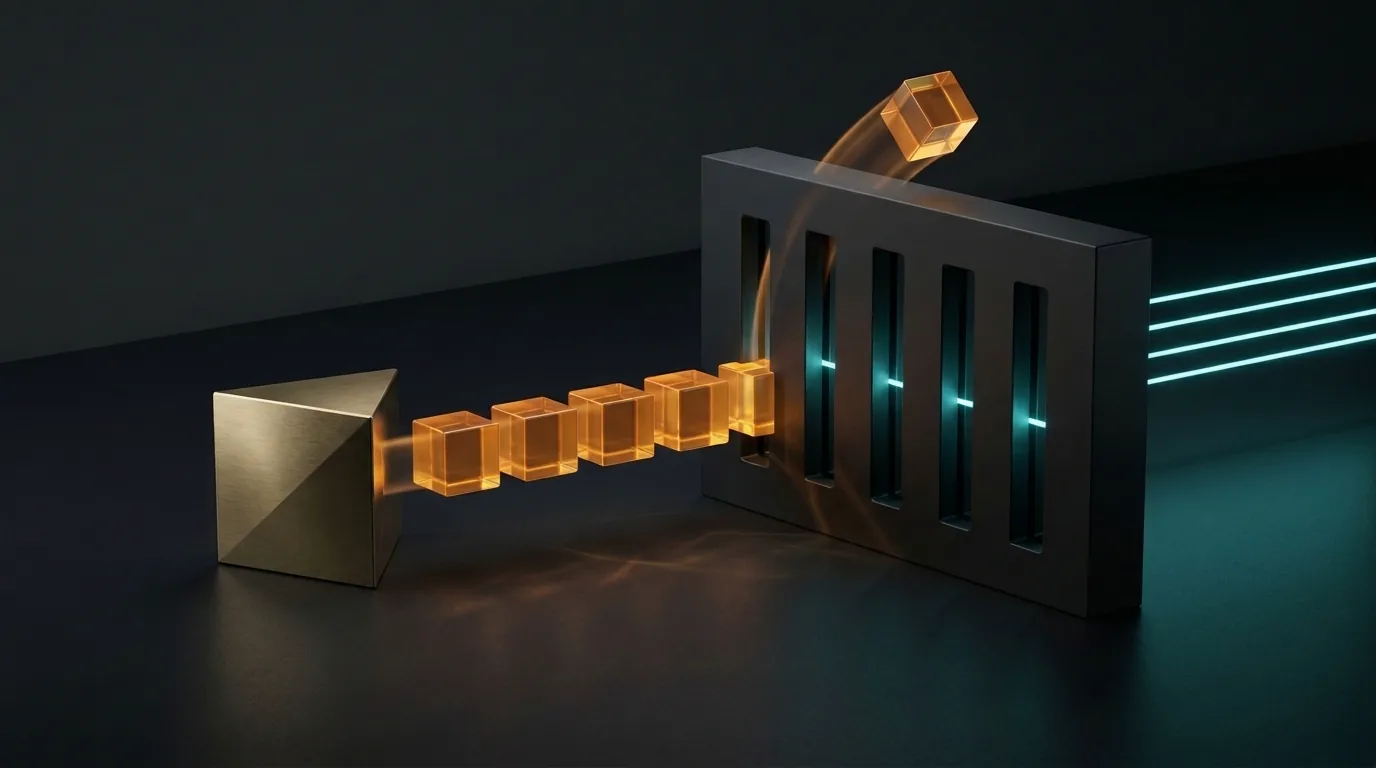
Apple Silicon developers running local LLMs on Mac Studio and M4/M5 MacBooks routinely see conflicting GGUF vs MLX advice because most desktop interfaces display only token-generation (decode) speed while hiding prompt-ingestion (prefill) latency. In Famstack’s wall-clock Apple Silicon benchmark ("57 tok/s on Screen, 3 tok/s in Practice"), an ~8K–8.5K context prompt running under standard LM Studio MLX took 49 seconds purely in prefill before emitting the first token—pulling effective end-to-end throughput down to ~3 tok/s despite headline decode rates.
Crucially, that bottleneck belongs to naive MLX serving paths rather than Apple’s unified-memory hardware itself. Dedicated Apple Silicon serving layers like oMLX pair custom fused Metal prefill kernels with RAM-and-SSD-tiered paged KV caching (persisting safetensors across turns and server restarts), cutting that exact 8K prefill penalty from 49 seconds down to roughly 1.7 seconds. For multi-turn coding agents that resend long repository prompts repeatedly, runtime KV caching matters far more than raw format choice.
GGUF Q4_K_M vs MLX 4-bit: perplexity degradation, tool calls, and long decode
Even at matched file footprints, GGUF and MLX quantize transformer weights differently. According to Atomic Chat’s quantization and latency benchmarks, llama.cpp’s mixed-precision GGUF Q4_K_M format (averaging ~4.83 bits per weight by reserving higher bit depth for attention and sensitive projection layers) exhibits up to 4.7x lower perplexity degradation than uniform 4-bit MLX quantization—preserving tighter JSON adherence and function-calling accuracy.
That creates a clean workload split across daily tasks: GGUF via llama.cpp (used by both Ollama and LM Studio) wins short interactive prompts, structured tool calls, classification, and strict 4-bit quality; standard MLX pulls ahead on sustained long outputs (250+ generated tokens) where unified-memory bandwidth dominates decode; and oMLX unlocks MLX for heavy agentic coding contexts where persistent KV reuse eliminates repeated prefill.
Hugging Face model coverage and M1/M2 bf16 hardware caveats
Model availability still tilts decisively toward GGUF for day-zero releases. Tracking from Outlier’s model-format index shows roughly eight times more GGUF-tagged repositories on Hugging Face than converted MLX builds—and GGUF checkpoints stay portable across Windows, Linux CUDA/ROCm, and macOS without re-quantizing weights.
Older Apple Silicon owners must watch one final architectural caveat: M1 and M2 chips lack native hardware bfloat16 (bf16) math pipelines (added in M3 and newer silicon). Loading bf16-centric MLX weights on M1/M2 triggers software conversion overhead that degrades prefill efficiency; on M1/M2 Macs, prefer FP16-compatible builds or well-tuned GGUF Q4_K_M/Q5_K_M checkpoints, while reserving MLX plus oMLX for M3/M4/M5 workstations.
Sources: GGUF vs MLX on Apple Silicon: Prefill & Quantization Benchmarks|Atomic Chat ↗ MLX vs GGUF on Apple Silicon: Wall-Clock Speed & oMLX Analysis|Famstack ↗ GGUF vs MLX Format Ecosystem & Hugging Face Coverage|Outlier ↗ Apple MLX Official Array Framework|GitHub ↗ llama.cpp Official GGUF Inference Engine|GitHub ↗
THE BROADER CONTEXT · FRONTIER LABS DOSSIER
Explore full product specifications, pricing analysis, and continuous coverage in the Frontier Labs Desk Hub and Others Dossier. Independent benchmarks available on the AI Intelligence Index and Coding Agents Leaderboard.