Seedream 5.5 Announced by ByteDance Seed: 100-Turn Edits and API Model Availability
ByteDance Seed showcases Seedream 5.5 with 100-round sequential image editing and native RGBA transparency, while developers track public API model identifiers.

THE STORY IN THREE POINTS
- ByteDance Seed unveiled Seedream 5.5 on November 9, 2026, demonstrating sequential editing across 100 conversational turns and native RGBA transparent layer synthesis.
- While preview access deployed across consumer applications including Dreamina, CapCut, and Higgsfield, direct API requests through SandBase and Volcano Engine return Model Not Found.
- Independent 22-case reproducibility testing (GeekCatX) observed 15/20 unedited regions preserved across 20 sequential edits (versus 0/20 on baseline), while ComfyUI Partner Node access launched November 11 via BytePlus.
Sequential multi-turn consistency: 100-round demo vs independent 20-round verification
ByteDance Seed announced Seedream 5.5 on November 9, 2026, emphasizing improvements in sequential instruction editing and visual artifact retention. Official showcase collateral demonstrates a single portrait undergoing 100 consecutive editing instructions while preserving unedited details such as rings and eyeglass frames. Because the 100-round showcase represents a vendor demonstration rather than a statistical pass rate, independent testers (GeekCatX) evaluated 22 multi-turn cases across 20 sequential modifications, finding that 15 of 20 runs preserved unedited regions intact compared to 0 of 20 on baseline comparison models.
In addition to multi-turn fidelity, Seedream 5.5 introduces native RGBA transparency support, outputting clean alpha channels for graphic design without secondary background removal. ByteDance self-reported a severe text rendering failure rate of 0.4% (and minor errors at 1.7%), compared with 2.8% on Seedream 5.0 Pro.
API endpoint audit: Why public model IDs return 404 while consumer apps function
Despite the November 9 announcement, developers attempting to call Seedream 5.5 directly via API discovered that public model identifiers were not yet active on launch day. Verification checks on SandBase returned "Model Not Found" errors, and ByteDance’s Volcano Ark November release table did not yet list a Seedream 5.5 API model ID (with Seedream 5.5 Pro teased without a release date).
Instead, Seedream 5.5 is currently accessible through consumer and partner surfaces: Dreamina, CapCut, Jimeng, Doubao, and Higgsfield (where 1K/1.5K generations are priced around $0.12 and 2K around $0.17). On November 11, a ComfyUI Partner Node also went live via BytePlus (starting around $0.02 per image). Developers verifying whether an endpoint actually runs 5.5 should check that both the model selector and the response payload explicitly return a 5.5 model ID rather than routing to 5.0.
Comparing Seedream 5.5 vs Seedream 5.0 Pro: Text rendering and layer control
For technical teams comparing Seedream 5.5 against Seedream 5.0 Pro, the upgrade centers on native RGBA transparency and multi-turn editing stability, while supported output resolutions (1K, 1.5K, and 2K) and single-batch counts (1–4 images) remain unchanged.
Engineers designing image workflows can track frontier benchmarks on our AI Leaderboards Hub and review comparative token generation models in our ChatGPT Images 2.6 analysis.
Sources: ByteDance Seed Official Research & Seedream Releases|ByteDance Seed ↗ Seedream 5.5 Integration, RGBA Settings and Pricing|Higgsfield AI ↗
THE BROADER CONTEXT · FRONTIER LABS DOSSIER
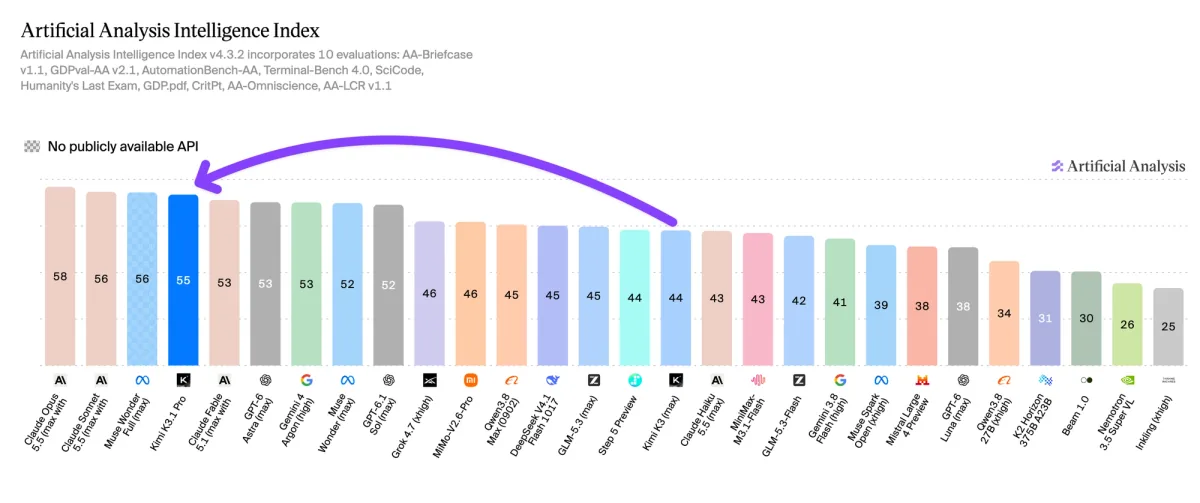
Explore full product specifications, pricing analysis, and continuous coverage in the Frontier Labs Desk Hub and Others Dossier. Independent benchmarks available on the AI Intelligence Index and Coding Agents Leaderboard.