OpenAI Launches ChatGPT Images 2.6 With GIFs, Reference Images, and Flare/Sunburst API Models
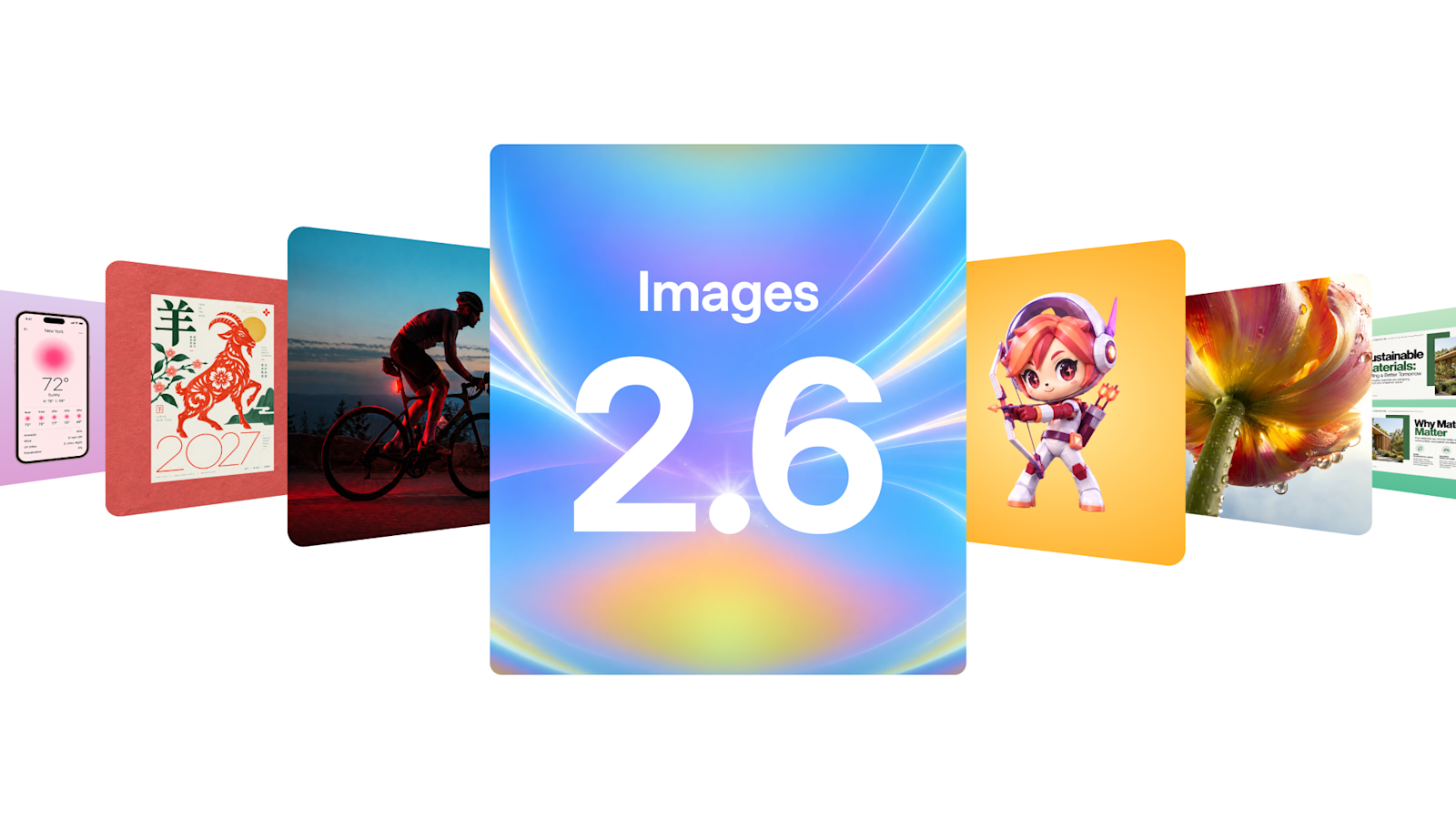
OpenAI launched Images 2.6 on November 4, 2026 in ChatGPT, Codex, and the API, adding GIFs, reusable reference images, and GPT-Image-2.6 Flare and Sunburst, with generation claimed 50% faster.
THE STORY IN THREE POINTS
- OpenAI launched Images 2.6 on November 4, 2026 in ChatGPT, Codex, and the API, adding GIFs, reusable reference images, and GPT-Image-2.6 Flare and Sunburst.
- OpenAI says images are 50% faster than before, and that Flare can finish in as little as about six seconds at quality low.
- Standard API list price for both 2.6 models, at check time, is $8 / $30 / $2 per 1M image tokens and $5 input / $1.25 cached per 1M text tokens.
At a glance
The release date is November 4, 2026, from the OpenAI blog and @OpenAI. Surfaces are ChatGPT and Codex on all tiers, across desktop, mobile, and web, plus API Flare and Sunburst, from the blog and the Help Center. OpenAI’s speed claim is that images are 50% faster than before, and that Flare can finish in as little as about six seconds at quality low, from the blog. ChatGPT GIFs go from a prompt or a still to a looping GIF, with adjustable playback speed and frame edits, from the blog, the Help Center, and X. Reference images let a user save a person, pet, or character and reuse it with @Name, from the Help Center and X.
API model IDs are gpt-image-2.6-flare and gpt-image-2.6-sunburst, from the blog and the API docs. API extras are markup edits, SVG export, a complexity dial, and GIF output via output_format set to gif, from the blog and the API docs. Standard list price is $8 input / $30 output / $2 cached per 1M image tokens, and $5 input / — / $1.25 cached per 1M text tokens, for both Flare and Sunburst, from the API pricing page.
ChatGPT: GIFs and saved references
OpenAI’s launch post and Help Center describe Images 2.6 as faster generation with stronger consistency across edit rounds. The company cites 4 billion images created per week across ChatGPT, Codex, and the API—more than half a billion per day on average—as usage context, not a quality metric.
GIFs are the headline consumer feature. Users can ask for a looping GIF from a prompt or upload a still and ask ChatGPT to animate it. The Help Center says GIF creation is rolling out in ChatGPT; users can open a generated GIF to adjust playback speed, save, or share. ChatGPT cannot edit an animated GIF the user uploads. The X announcement’s “GIFs and reference images” line matches those Help Center sections.
Reference images let users upload a photo and ask ChatGPT to save it as a named reference—or accept a save offer when describing, for example, a pet. Later prompts can call the reference with @ plus the saved name (Help Center example: “Make a watercolor portrait of @Pepper”). OpenAI’s X copy and community and product messaging frame this as keeping yourself, pets, and characters reusable without re-uploading. The November 4 index blog emphasizes character, product, and brand consistency in edits but points readers to product surfaces for the save and @ workflow documented in the Help Center.
API: Flare, Sunburst, and GIF parameters
Developers get GPT-Image-2.6 Flare for speed-oriented work and GPT-Image-2.6 Sunburst for higher detail and stronger edit consistency when quality is set to medium or high. At quality low, OpenAI says Flare can finish in as little as six seconds. Flare is also called out for layout quality on posters and product imagery. Image markup—already in ChatGPT—comes to the API; SVG export and a new complexity parameter (planning effort, separate from render quality) ship with the release.
API docs document animated GIF output on POST /v1/images/generations with output_format set to gif. Controllable fields include frame_count (docs and examples commonly 2–16, default 9) and frame_duration_ms (about 20–2000, default 200, rounded to 10 ms). GIF generation does not support streaming, partial images, custom output_compression, or prompt_rewriter; the edit endpoint does not support GIF output. Model IDs in current docs include gpt-image-2.6-flare and gpt-image-2.6-sunburst.
Standard API list pricing for both 2.6 models, as shown on OpenAI’s pricing page at check time, is $8 input / $30 output / $2 cached per 1M image tokens and $5 input / $1.25 cached per 1M text tokens (text output marked “—” in the Standard table). OpenAI points developers to the image-generation cost calculator for per-image estimates.
What first-party pages confirm
Confirmed from first-party pages: the Images 2.6 launch date, GIF support, reference-image reuse in ChatGPT, the Flare and Sunburst API split, the roughly six-second Flare claim at low quality, roughly 50% faster generation, global ChatGPT and Codex availability across subscription tiers, and API markup, SVG, and complexity. Treat the 50% and six-second figures as OpenAI’s performance claims. GIF “rolling out” language in the Help Center means availability may still be phased even though the blog says Images 2.6 is available globally today.
Bottom line
Images 2.6 is a product-and-API capability release: motion via GIFs, sticky character references in ChatGPT, and a dual Flare and Sunburst API lineup aimed at faster loops and tighter edit consistency—not a separately branded foundation-model launch. Builders should verify GIF preview access, quality and complexity settings, and current list prices against OpenAI’s live docs before migrating production traffic.
Sources: Introducing Images 2.6|OpenAI ↗ Images in ChatGPT|Help Center ↗ Image generation|API docs ↗ API Pricing|Image generation models ↗ @OpenAI announcement ↗