OpenAI Decisions API reaches GA for fast classification, routing and scoring
The GPT-6 Luna endpoint now handles up to 400 questions per request. Its input-based pricing includes discounted cache reads and charged cache writes, while answers carry no output-token fee.
THE STORY IN THREE POINTS
- Decisions API is generally available, with three defined answer types and up to 400 questions sharing one input.
- Standard uncached input costs $0.10 per million tokens; cache reads cost $0.01 and 30-minute writes cost $0.125.
- The dedicated endpoint suits bounded judgments; applications still define the rules and act on the answers.
A dedicated endpoint for frequent judgments
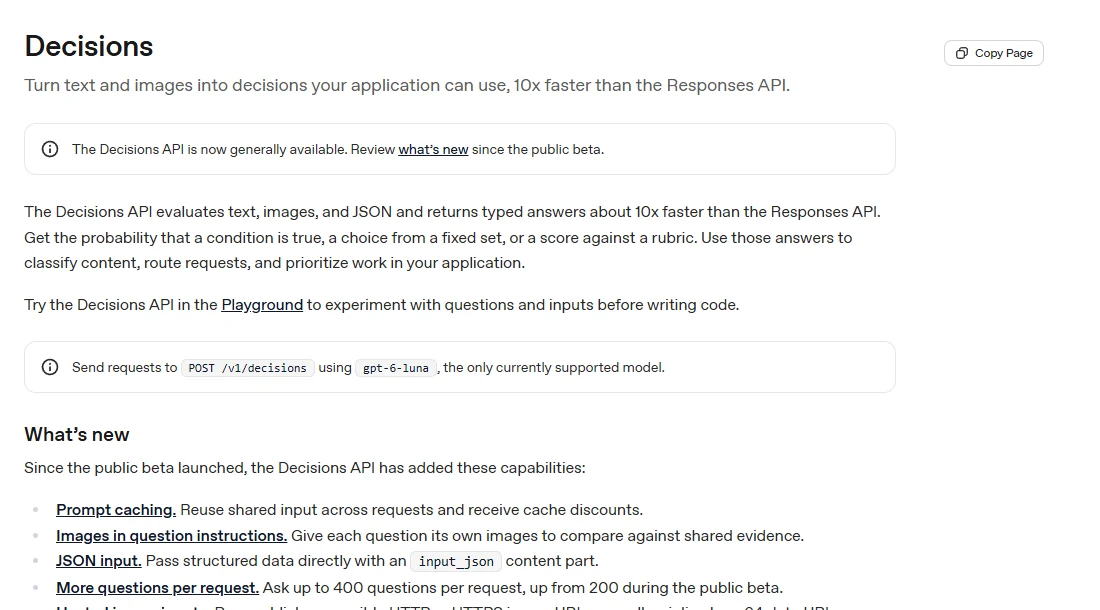
OpenAI made the Decisions API generally available on October 22, according to its API changelog. The service uses GPT-6 Luna and accepts requests at POST /v1/decisions. This report was published on October 24 after checking the current documentation.
OpenAI claims up to ten times faster judgments than GPT-6 Luna through the Responses API. This is the vendor’s comparison, without an independent reproduction here. It describes a decision workload, rather than guaranteeing latency or a tenfold improvement across an entire agent.
Three answer types, with the application in control
The API reference defines three question types. A predicate estimates whether a condition is true. A choice selects from options supplied by the developer. A score evaluates ordered levels. Each request accepts 1–400 questions, and the returned answers preserve their order. GPT-6 Luna is currently the only supported model.
Predicates return probabilities from zero to one. Choice and score include distributions plus separate confidence values. A score is a probability-weighted average of level indices, which can lie between levels; choice selects a category.
What changed after the public beta
The October 22 changelog highlights shared-input caching, images within individual question instructions, and native structured data through input_json. The question limit doubles from the beta’s 200 to 400. Those changes let developers reuse evidence while varying the judgments they ask the model to make.
The guide also lists hosted image URLs, conversation history with tool calls and results, usage reporting, Private Link and native GPT-Live integration. These arrived during the period since beta began; they did not necessarily all debut on GA day.
Input-based pricing still includes cache-write costs
At standard rates, uncached Decisions input costs $0.10 per million tokens and output tokens are free. Cache reads use the standard Luna rate of $0.01 per million. A 30-minute cache write costs $0.125 per million: caching is therefore not a blanket exemption from input charges. Regional and long-context adjustments can apply.
The Decisions reference currently accepts only a 30m cache lifetime. The general pricing table’s $0.25-per-million 12-hour write tier should not be presented as an available Decisions setting. Cache-write rates replace the ordinary input rate for those tokens; they are not an additional charge on top. Reuse frequency determines whether caching lowers a particular bill.
Availability and retention require separate checks
The data-controls documentation lists Decisions across supported API regions, while regional inference is available in the United States and Europe, including the EEA and Switzerland. Availability in another storage region does not establish that processing occurs there.
Zero Data Retention is available to eligible customers with documented exceptions, including caching and image safeguards. HIPAA use requires the relevant agreement and account configuration. These are eligibility and configuration conditions, rather than assurances that every account or request automatically meets them.
Editorial context: measure the decision that matters
Our assessment is that the useful adoption unit is one recurring judgment: which queue receives a request, whether a workflow needs review, or how urgently a case should be handled. Define what a correct answer means before comparing implementations. A quick wrong route still creates work elsewhere in the system.
A practical evaluation would compare accuracy, end-to-end latency and total cost on the same examples, including ambiguous cases. Track the cost of mistaken approvals and missed escalations separately. Confidence can support a review policy, but a numerical confidence value alone does not establish that a business rule has been satisfied.
For custom JSON-schema generation, OpenAI recommends Responses with Structured Outputs; for requesting tools with arguments, function calling. Decisions supplies judgments to the application. Clear responsibilities make individual routing steps easier to test and the workflow’s improvement easier to measure.
Sources: OpenAI API changelog: October 22 Decisions API general availability ↗ OpenAI Decisions guide: capabilities, answer interpretation and endpoint billing ↗ OpenAI API reference: create a decision and supported cache controls ↗ OpenAI API pricing: standard GPT-6 Luna cache-read and cache-write rates ↗ OpenAI prompt-caching guide: write-rate accounting and cache lifetimes ↗ OpenAI data controls: Decisions retention, HIPAA eligibility and regional support ↗