OSWorld-Verified Explained: Leaderboards, Results and OSWorld 2.0
The OSWorld research consortium upgrades OSWorld-Verified and releases OSWorld 2.0, establishing rigorous evaluators and multi-application workflows for operating system computer use agents.
THE STORY IN THREE POINTS
- OSWorld-Verified upgraded the benchmark on July 28, 2025, auditing 369 original tasks and excluding 8 unreliable Google Drive tasks to establish a 361-task validated evaluation set.
- OSWorld 2.0 released on June 26, 2026, introducing 108 challenging long-horizon workflow tasks that test complex multi-application desktop productivity.
- The benchmark suite separates official verified leaderboards from vendor self-reports, providing rigorous partial and binary scoring to evaluate GUI agents against human performance.
Task audit and methodology: The OSWorld verified benchmark leaderboard
Evaluating autonomous agents across real operating systems requires addressing non-deterministic application states and brittle test scripts. The OSWorld benchmark, developed by XLANG Lab and partner institutions, created the primary open environment for evaluating multimodal agents on Ubuntu, Windows, and macOS desktop environments. On July 28, 2025, the team introduced OSWorld-Verified, refining evaluation integrity across the official OSWorld verified benchmark leaderboard.
In the original 369-task suite, certain external dependencies produced false execution failures. The OSWorld verified evaluation detailed in the OSWorld verified paper and hosted on the OSWorld verified GitHub repository (xlang-ai/OSWorld) filtered out 8 unreliable Google Drive tasks—leaving 361 verified tasks across LibreOffice, Chrome, Thunderbird, and system utilities—and repaired fragile evaluation scripts. Rather than relying on simple pixel matching, verified evaluators inspect underlying application states and file-system artifacts.
Long-horizon productivity: Understanding the OSWorld 2.0 leaderboard
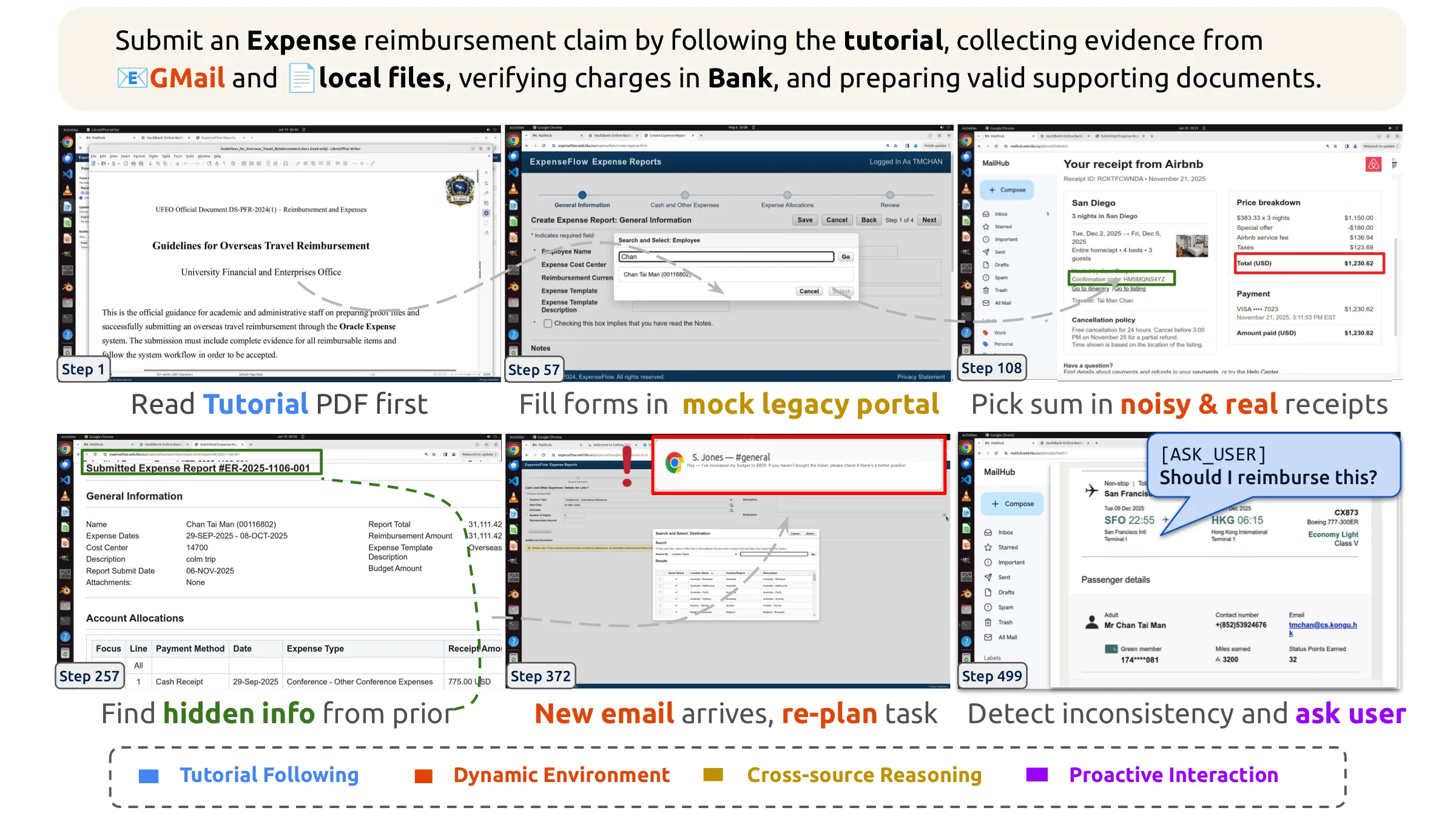
On June 26, 2026, the research consortium released OSWorld 2.0, introducing 108 complex long-horizon workflow tasks tracked on the OSWorld 2.0 leaderboard (hosted at osworld-v2.xlang.ai). While version 1 tasks focused primarily on individual operations within single software packages, version 2 evaluates intricate cross-application workflows, such as extracting data from online tables, formatting statistical spreadsheets, and preparing email distributions.
A central advancement in OSWorld 2.0 is the incorporation of granular partial scoring alongside traditional binary pass/fail metrics. Because complex workflows require dozens of coordinated mouse and keyboard actions, partial credit provides deeper diagnostic insight into where agent planning diverges, establishing an updated standard for OSWorld computer use research.
Interpreting scores: The OSWorld verified leaderboard and evaluation methodology
When reading OSWorld verified results on the official OSWorld verified leaderboard (hosted at osworld-v1.xlang.ai), developers must distinguish between official benchmark submissions and vendor-reported numbers. For evaluations involving OSWorld verified Claude entries or open-weight models, score differences frequently depend on agent scaffolding—such as structured observation parsers, coordinate normalization, and step-budget enforcement—rather than raw foundation model reasoning alone.
Evaluating OSWorld submissions requires verifying experimental setups: whether an agent operates under the standard 15-step budget or extended interaction limits, and whether scores reflect binary task completion or partial diagnostic credit. Benchmark documentation on the OSWorld verified GitHub repository provides reproducible task harness configs, ensuring that research reports—such as specialized checkpoint evaluations discussed in our analysis of NorthCUA coordinate handling and our broader guide to computer use agents—can be interpreted within their defined test constraints.
Sources: OSWorld 2.0 Benchmark Announcement & Specifications|XLANG Lab ↗ OSWorld-Verified Benchmark & Leaderboard Documentation|XLANG Lab ↗ OSWorld Evaluation Suite & Task Definitions Repository|GitHub ↗
THE BROADER CONTEXT · FRONTIER LABS DOSSIER
Explore full product specifications, pricing analysis, and continuous coverage in the Frontier Labs Desk Hub and Others Dossier. Independent benchmarks available on the AI Intelligence Index and Coding Agents Leaderboard.