Mistral Large 4 Review: Specs, Cyber Benchmarks & License
Independent review of Mistral Large 4 ("Le Chonk"): 1.05T vs. 675B spec clarity, Artificial Analysis v5 score (26), 41% Terminal-Bench 4.0 gain, top cybersecurity results with zero safety refusals, and MEOW MaaS licensing.
THE STORY IN THREE POINTS
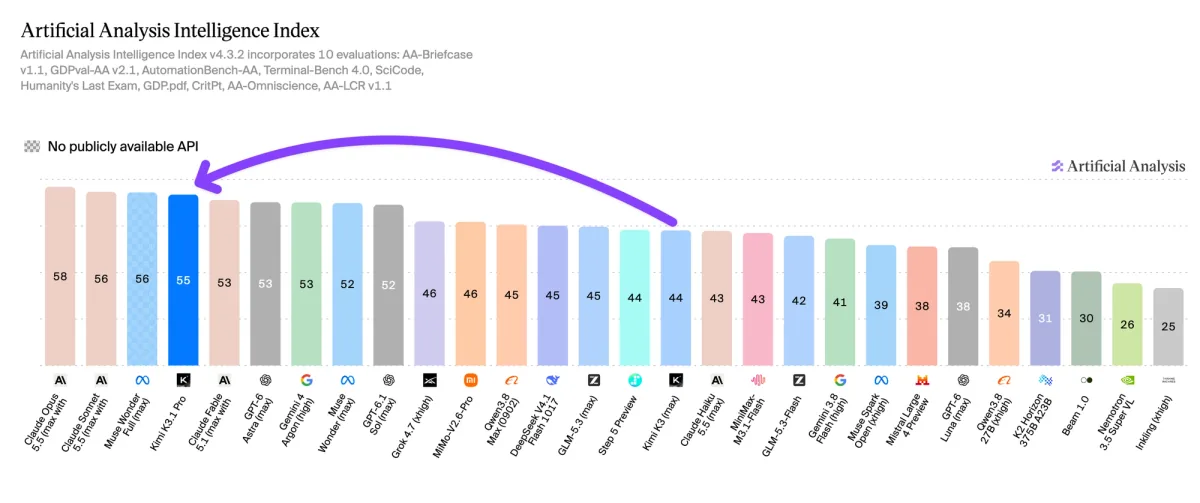
- Specs and intelligence verdict: Mistral Large 4 ("Le Chonk") ships as 1.05T total / ~52B active multimodal MoE weights (49B active per token plus embeddings) with a 1M window, scoring 26 (High) on Artificial Analysis Intelligence Index v5—leading non-China open weights while trailing DeepSeek V4.1 Flash and GLM-5.3 (32 at launch).
- Breakout cybersecurity strength: Hugging Face’s October 29 release blog reports 82% on the AA Cyber Index vulnerability reproduction-and-patch suite, 93% on Cybench, and 93.3% Lakera B3 attack resistance—while Lindy.ai notes 0% task refusals where closed peers refused 98.5%–100%.
- MEOW license caveat: released under the Mistral Ecosystem Open-Weight license (MEOW, a modified MIT license), weights are free for research, fine-tuning, and embedded products, but operating a commercial Model-as-a-Service API requires a separate license from Mistral.
Verdict: why AppSec and sovereign teams adopt Mistral Large 4
Mistral Large 4—officially nicknamed Le Chonk, previewed on October 6, 2026, and released as downloadable open weights on October 29, 2026—is not an all-purpose reasoning chart topper, and judging it purely on general chat scores misses why engineering and security organizations deploy it. While its High reasoning configuration scores 26 on the Artificial Analysis Intelligence Index v5 (trailing October open-weight co-leaders DeepSeek V4.1 Flash and GLM-5.3 at 32), its combination of strong token efficiency, 1M multimodal context, and unrestricted defensive security execution sets it apart from both US closed flagships and permissive Chinese open weights.
For European enterprises and regulated builders comparing sovereign options against Chinese open checkpoints, Mistral Large 4 pairs native vision and European cluster training (on 3,800 NVIDIA Grace Blackwell GPUs) with a sharper commercial boundary: the Mistral Ecosystem Open-Weight license (MEOW) replaces Mistral Large 3’s Apache 2.0 terms with explicit Model-as-a-Service (MaaS) licensing controls, as detailed in our October 29 open-weight launch coverage and October 6 preview report.
Architecture and resolving the 675B vs. 1.05T parameter discrepancy
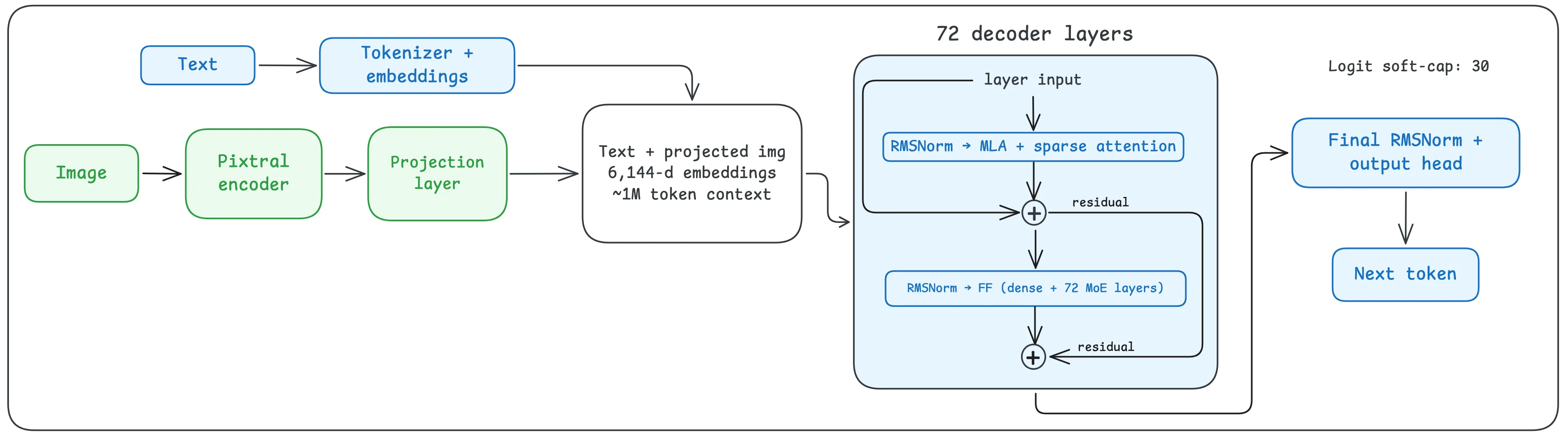
Architecturally, Mistral Large 4 is a sparse Mixture-of-Experts (MoE) multimodal model built around 72 text decoder layers, a 6,144 hidden dimension, 64 attention heads, a 3:1 RoPE-to-NoPE layer schedule, and a ~1.6B-parameter Pixtral-style native vision encoder spanning a 1,000,000-token context window. Rather than attending densely across the full prompt, it combines Multi-head Latent Attention (MLA) with a DeepSeek Sparse Attention (DSA) indexer selecting up to 2,048 key positions per query while routing tokens through 4 of 128 routed experts plus one shared expert (Hugging Face’s Le Chonk release post).
Infrastructure teams reading third-party trackers often spot conflicting parameter counts—and Shattered.io’s parameter-gap investigation documented how early preview listings cited 675B total / 41B active parameters. Official Mistral documentation and the Hugging Face model card (mistralai/Mistral-Large-4-1T-A52B, shipped in FP8 and Blackwell NVFP4) settle the production footprint at 1.05 trillion total parameters with 49B active parameters per token and approximately 52B active including embeddings and output heads. Always size enterprise multi-GPU clusters around the 1.05T / 52B footprint—consumer single-node GPUs cannot host full weights locally.
General intelligence, token efficiency, and Arena standings
Across independent general evaluations, Mistral Large 4 sits in the competitive upper-middle tier while posting dramatic efficiency gains over its early October preview. On Artificial Analysis Intelligence Index v5, the October 29 open-weight release (High effort) scores 26—up one point from the Preview’s 25, first among non-China open weights in AA’s October snapshot, and six points behind DeepSeek V4.1 Flash and GLM-5.3 at 32 (with DeepSeek V4.1 Flash later reaching 33 on v5.0.1 Max). Separately, BenchLM tracks an overall public benchmark aggregate of 56.4/100 across 20 benchmark rows, while LMArena’s November 18 Text Arena snapshot places Mistral Large 4 at 1,412±8 Elo.
The bigger operational upgrade between Preview and open-weight GA is verbosity and hallucination control. Artificial Analysis reports that Mistral Large 4 High uses roughly 82,000 output tokens per Intelligence Index task versus approximately 135,000 tokens for the Preview—a 39% reduction in output tokens—while cutting AA-Omniscience v1.1 hallucinations from 41% down to 28%. Combined with Mistral’s halved API list pricing ($0.70 input, $0.07 cached input, and $2.10 output per million tokens vs. $1.36/$4.18 in preview, per TrueFoundry and CellCog), AA’s estimated Intelligence Index task cost drops 63% from $5.54 to $2.06.
Coding agent benchmarks: separating Preview vs. Open-Weight scores
Comparing coding numbers across Mistral and Hugging Face launch posts requires reading evaluation variants carefully. In Hugging Face’s October 29 post, Mistral Large 4 records 61.7% on DeepSWE v1.1, 59.4% on SWE-Atlas-QnA, 59.9% on AutomationBench, 1,393 Elo on AA-Briefcase, and a 49.8% Coding Agent Index score ahead of DeepSeek V4 Pro 0813 and Qwen3.8-Max (corroborated by AA near 48%, effectively tying GLM-5.3 with roughly 47% fewer tokens per task).
Terminal-Bench numbers in circulation span two milestones that blogs occasionally conflate: Hugging Face’s blog cited 28.3% on Terminal-Bench 4 alongside those baseline tables, whereas Mistral’s October 29 OSS release blog explicitly reports that reinforcement learning lifted the downloadable open-weight checkpoint by 13 percentage points over Preview to 41% on Terminal-Bench 4.0 while using 30% fewer output tokens. Even at 41%, specialized open-weight coding leaders such as Kimi K3.1 Pro (67% on Terminal-Bench 4.0) maintain a wide lead on raw terminal execution.
Cybersecurity advantage: reproduction, Cybench, and refusal behavior
Cybersecurity is the category where Mistral Large 4 decisively breaks away from closed frontier competition. On the Artificial Analysis Cyber Index vulnerability reproduction-and-patching suite—which tests whether a model can discover, reproduce, and remediate real flaws in open-source software—Hugging Face’s release post reports 82%, noting that several closed frontier models score near zero because safety filters refuse to touch exploit reproduction steps. Mistral Large 4 also solves 93% of Cybench’s 40 security competition challenges and achieves 93.3% attack resistance on Lakera’s B3 prompt-injection benchmark, while still posting the highest refusal rate among open weights on harmful cyber requests across JailbreakBench, StrongREJECT, and AgentHarm.
Independent commentary from Lindy.ai reinforces that practical edge on Cyber Index: reporting a composite Cyber Index score of 51 and 79.4% completion on reproduce-and-patch tasks with 0% refusals, whereas closed frontier baselines Claude Opus 5.5 and GPT-6 Astra refused 98.5% and 100% of those prompts due to automated safety policies. For authorized AppSec teams, incident responders, and open-source vulnerability pipelines, hosting open weights removes both false refusals and sudden API revocation risks.
MEOW license limits and who should deploy Mistral Large 4
Teams upgrading from Apache 2.0 Mistral Large 3 must review the Mistral Ecosystem Open-Weight license (MEOW) carefully. Described by Mistral as a modified MIT license, MEOW lets organizations download, inspect, fine-tune, run internally, and embed the weights inside downstream applications free of charge—but operating a Model-as-a-Service (MaaS) offering that hosts or resells model access as a public API requires a separate commercial license from Mistral. Hosted API operators wanting zero MaaS strings remain better served by MIT-licensed DeepSeek V4/V4.1 weights or Apache 2.0 Qwen checkpoints.
Overall, deploy Mistral Large 4 when European data residency, concise output-token economics, 1M-context multimodal understanding, or defensive AppSec and vulnerability-remediation pipelines are primary requirements. Look elsewhere—such as Kimi K3.1 Pro or DeepSeek V4.1 Flash—if you want top open-weight composite reasoning, single-workstation self-hosting, or unrestricted commercial API reselling.
Sources: Mistral Large 4 (Le Chonk) Is Now Open Weight|Mistral AI ↗ Introducing Mistral Large 4 (Public Preview)|Mistral AI ↗ Welcome Le Chonk: Mistral Large 4 on Hugging Face|Hugging Face Blog ↗ mistralai/Mistral-Large-4-1T-A52B Model Card|Hugging Face ↗ Mistral Large 4 Parameter Count Gap Investigation|Shattered.io ↗ Mistral Large 4 Cyber Index, Refusal & Pricing Analysis|Lindy.ai ↗ Mistral Large 4 Benchmark Profile|BenchLM ↗ Mistral Large 4 Review & API Pricing|TrueFoundry ↗
THE BROADER CONTEXT · FRONTIER LABS DOSSIER
Explore full product specifications, pricing analysis, and continuous coverage in the Frontier Labs Desk Hub and Others Dossier. Independent benchmarks available on the AI Intelligence Index and Coding Agents Leaderboard.