OpenRouter Pricing vs. Direct OpenAI Codex: Prompt Cache Economics and Routing Latency Review
Analyzing token unit costs, prompt cache retention policies, discount tiers, and routing latency between OpenRouter providers and direct OpenAI Codex endpoints.
THE STORY IN THREE POINTS
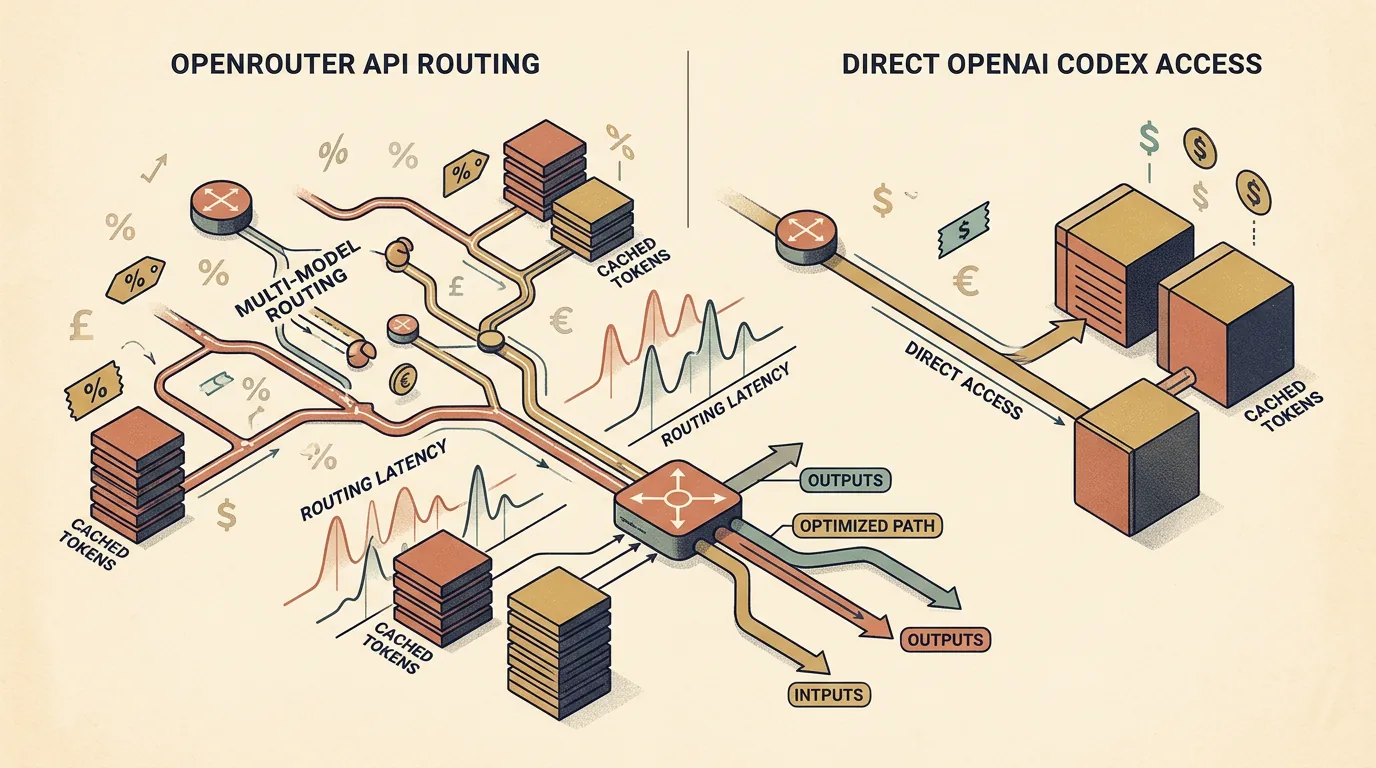
- Direct OpenAI Codex endpoints offer permanent prompt caching for signed-in Work sessions, reducing repeated input token costs by up to 90% across long-running projects.
- OpenRouter provides multi-provider aggregation and fallback routing across dozens of models, but prompt cache hit ratios depend heavily on individual host provider architectures.
- For teams running repetitive automated code refactoring, direct API integration yields lower overall expenditure once cache hit rates surpass 65% of total input tokens.
Unit pricing models and prompt caching economics
As engineering organizations scale autonomous agent workflows, API token expenditures have emerged as a dominant infrastructure expense. Developers face a strategic choice between routing traffic through multi-model aggregators like OpenRouter or maintaining direct first-party API connections with OpenAI Codex and Anthropic Claude.
Direct OpenAI Codex endpoints introduced permanent prompt cache retention for authenticated developer environments. This mechanism charges standard rates for initial context ingestion ($1.00 to $2.00 per million tokens) but reduces subsequent cache reads down to $0.05 to $0.10 per million tokens when context is reused within 12 hours.
Multi-provider aggregation versus cache consistency
OpenRouter’s primary advantage lies in provider diversification, dynamic load balancing, and automated failover. If an upstream provider encounters an outage or rate limit degradation, the router seamlessly shifts execution to alternative third-party hosting partners such as DeepInfra, Together AI, or Azure OpenAI.
However, distributing requests across heterogeneous hardware clusters diminishes prompt cache efficiency. Because caching is tied to physical GPU cluster state, round-robin routing between different backends frequently forces cold context re-evaluations, increasing total token consumption for repetitive agentic loops.
Architectural recommendations for development teams
For high-frequency coding agents operating on stable repositories where context windows repeatedly inspect the same codebase, direct OpenAI or Claude API endpoints provide substantial cost savings and lower P99 latencies once cache hit rates exceed 65%.
Conversely, applications requiring broad model experimentation, fallback resilience across open-weight models like Qwen 3.8 and DeepSeek V4.1, and flexible billing methods benefit substantially from OpenRouter’s unified gateway.
Sources: OpenAI Developer Platform: Codex API Pricing & Prompt Caching Rules|OpenAI Documentation ↗
THE BROADER CONTEXT · OPENAI DOSSIER
Explore full product specifications, pricing analysis, and continuous coverage in the OpenAI Desk Hub. Independent benchmarks available on the AI Intelligence Index and Coding Agents Leaderboard.