OpenAI Launches GPT-6.2 Astra and GPT-6.2 Sol With Ultrafast Mode, 20% Lower Flagship Pricing, and Daybreak Cyber Plans
Now live across ChatGPT Work, Codex, and the OpenAI API, GPT-6.2 Astra drops base input/output rates 20% below GPT-6 Astra to $8/$40 while GPT-6.2 Sol keeps $2/$10 pricing and expands Ultrafast mode to Pro 200.
THE STORY IN THREE POINTS
- OpenAI rolled out gpt-6.2-astra and gpt-6.2-sol across ChatGPT Work, Codex (Plus, Pro, Enterprise, and Edu), and the OpenAI API, introducing Fast and Ultrafast execution tiers (with Ultrafast priced half off at 3x Standard for API and Enterprise customers over the next three months, and opening to Pro 200 users on Sol alongside Pro 500 on both models).
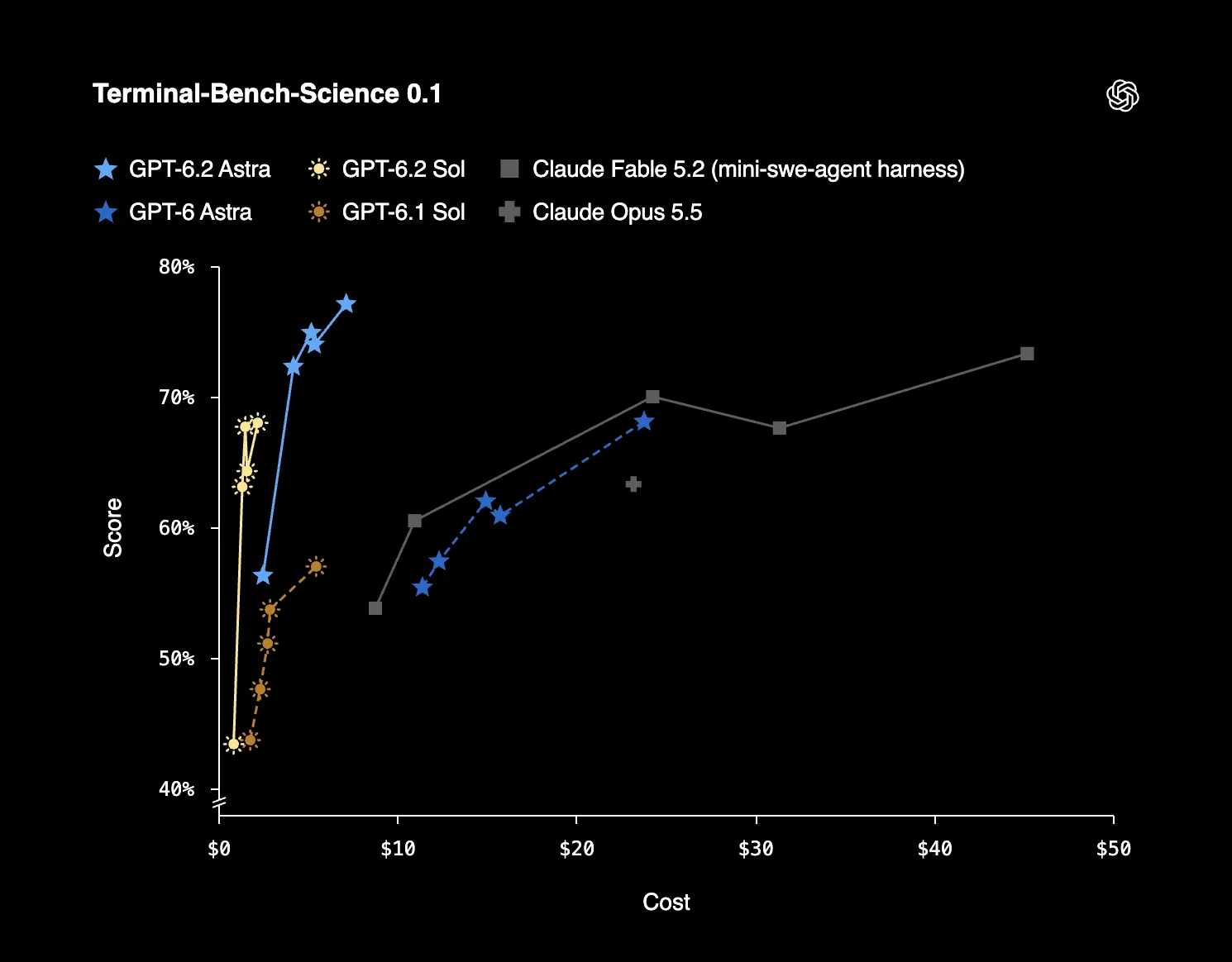
- Standard API rates fall 20% on flagship GPT-6.2 Astra ($8.00 input / $0.40 cached / $40.00 output per 1M tokens vs GPT-6 Astra’s $10/$50), while OpenAI reports gains of +9 percentage points on Terminal-Bench Science 0.1 and +5.2 on Agents’ Last Exam at under one-third the cost, +32% on BenchCAD 2.1 Core, and +22 points on ExploitBench Internal Port.
- For everyday software engineering, OpenAI recommends GPT-6.2 Sol—matching GPT-6.1 Sol’s $2.00/$10.00 pricing while trailing Astra by under 0.5 points at max reasoning on Cognition FrontierCode 2.0 at roughly one-fifth the cost, as both models prepare to join Daybreak with tighter safeguards against offensive cyber misuse.
ChatGPT Work, Codex & API rollout: 20% lower flagship pricing and Ultrafast promo
OpenAI officially shipped GPT-6.2 Astra (gpt-6.2-astra) and GPT-6.2 Sol (gpt-6.2-sol) across ChatGPT Work, Codex (Plus, Pro, Enterprise, and Edu plans), and the OpenAI API, positioning both releases around practical real-world execution efficiency rather than raw benchmark scale alone. Standard API pricing on flagship GPT-6.2 Astra cuts list rates 20% below September’s GPT-6 Astra—moving from $10/$50 down to $8.00 per million input tokens ($0.40 cached input) and $40.00 per million output tokens—while everyday workhorse GPT-6.2 Sol preserves GPT-6.1 Sol’s $2.00/$0.10/$10.00 schedule alongside higher task capability (with standard >272K long-context multipliers applying).
Speed tiering marks an equally notable product shift. Both gpt-6.2-astra and gpt-6.2-sol expose Fast and Ultrafast inference modes, with OpenAI offering Ultrafast at half price over the next three months—making Ultrafast cost 3x Standard rates for API and Enterprise buyers. Inside ChatGPT and Codex subscriptions, Pro 500 users gain Ultrafast access across both models immediately, while OpenAI opens Ultrafast to Pro 200 subscribers for the first time starting with GPT-6.2 Sol.
Science, 3D CAD & FrontierCode benchmarks—plus Daybreak cybersecurity enrollment
In launch evaluations reported by OpenAI and OpenAI Developers, GPT-6.2 Astra posts broad improvements across software engineering, frontend interfaces, 3D modeling, and multi-step tool calling over GPT-6 Astra: gaining 9 percentage points on Terminal-Bench Science 0.1 at less than one-third the cost, +5.2 points on Agents’ Last Exam at less than one-third the cost, +32% on BenchCAD 2.1 Core, and +22 points on ExploitBench Internal Port. Even so, OpenAI explicitly steers day-to-day coding workflows toward GPT-6.2 Sol first: at maximum reasoning effort on Cognition’s FrontierCode 2.0, Sol finishes within 0.5 points of Astra at roughly one-fifth the task cost.
Because ExploitBench gains make GPT-6.2 OpenAI’s strongest cybersecurity release yet—crossing the Critical Cybersecurity and High Biological/Chemical thresholds under OpenAI’s Preparedness Framework, with Astra also crossing High on AI Self-Improvement—the lab paired deployment with stricter safeguards against high-risk offensive cyber assistance. Following the vetted-defender blueprint established for GPT-6 Cyber and OpenAI’s Daybreak program, OpenAI plans to onboard both GPT-6.2 models into Daybreak so approved defenders encounter fewer false refusals—completing the transition from the earlier GPT-6.2 client telemetry sightings.
Why early influencer videos diverged from launch builds—and Tibo’s candid assessment
Addressing mixed early social reactions alongside the launch, OpenAI’s Thibault Sottiaux (@thsottiaux)—who confirmed he runs GPT-6.2 Sol with Ultrafast on Pro 200 as his daily driver—explained why early creator reviews felt out of step with public launch impressions. According to Sottiaux, a small cohort of early testers received pre-release access before OpenAI landed major model changes over the final three to four days ahead of release, and most videos recorded the previous week were published without re-testing the updated weights.
Sottiaux struck an unusually candid tone regarding launch expectations: while emphasizing that GPT-6.2 Astra and Sol deliver a clear step up over prior GPT-6 and GPT-6.1 checkpoints, he acknowledged the models remain imperfect and said engineering teams are continuing to refine "taste and niceness of use" in upcoming iterations, encouraging Pro 200 and Pro 500 subscribers to try Sol Ultrafast directly for a noticeably faster interactive loop.
Sources: Introducing GPT-6.2 Astra and Sol|OpenAI ↗ GPT-6.2 Astra and Sol Launch Announcement (@OpenAI)|X ↗ GPT-6.2 Astra Terminal-Bench Science 0.1 Results (@OpenAIDevs)|X ↗ GPT-6.2 Sol Ultrafast Expansion to Pro 200 (@thsottiaux)|X ↗ Notes on Pre-Release Reviewer Timing & Ongoing Refinements (@thsottiaux)|X ↗ OpenAI API Pricing (GPT-6.2 Astra & Sol)|OpenAI Developers ↗
THE BROADER CONTEXT · OPENAI DOSSIER
Explore full product specifications, pricing analysis, and continuous coverage in the OpenAI Desk Hub and GPT Models Dossier. Independent benchmarks available on the AI Intelligence Index and Coding Agents Leaderboard.