GPT-6.2 Ahead of Release: Why the Version Suffix Is a Tier Counter Rather Than a Capability Leap
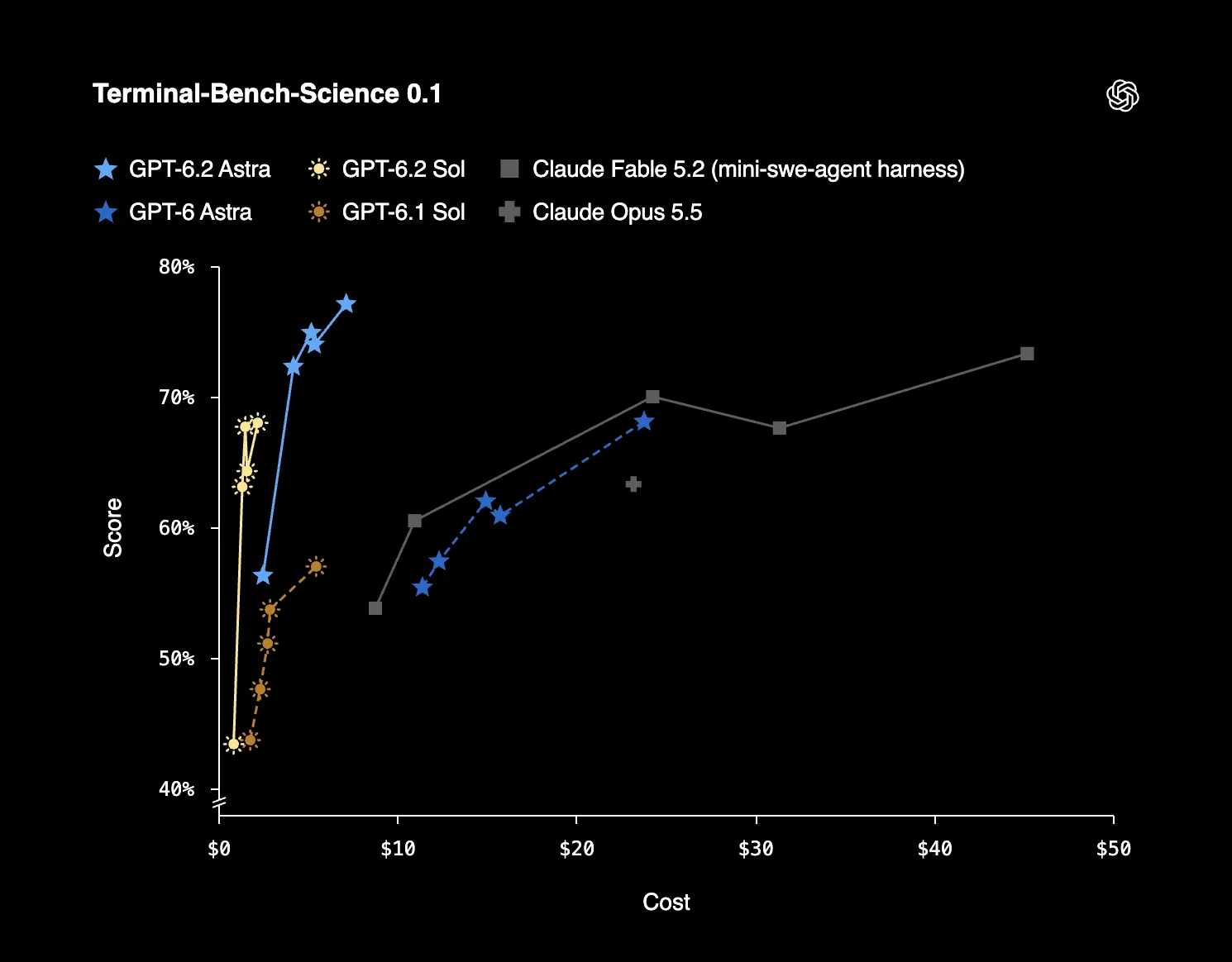
With gpt-6.2-astra routing flags appearing across Codex usage telemetry, analysis of OpenAI’s naming taxonomy shows Sol and Astra carry independent version milestones rather than a simultaneous dual-flagship ladder.

THE STORY IN THREE POINTS
- Codex usage logging surfaced internal identifiers for gpt-6.2-astra accounting for 19.8% to 37.7% of daily developer requests, yet OpenAI’s public model catalog and front-end selectors remain locked to GPT-6 Astra.
- Contrary to commentary framing the upcoming release as a "dual flagship," the Sol suffix indicates an independent sub-tier counter: GPT-6.1 Sol ($2/$10) is a cost-optimized mid-tier, while Astra ($10/$50) anchors the frontier capability line.
- A reliable test for general availability: developers should disregard background routing telemetry until OpenAI’s model selection drop-down and the API response payload return matching 6.2 strings.
Behind the routing curtain: What developer Codex telemetry actually reveals
Anticipation for OpenAI’s next model release spiked sharply following developer reports of internal model strings appearing inside live coding environments. From October 31 through November 9, enterprise Codex accounts noticed unexpected billing telemetry: specific automated tasks recorded model execution under gpt-6.2-astra, occasionally capturing between 19.8% and 37.7% of daily background runs.
Crucially, OpenAI’s public user interface told an entirely different story. The front-end model dropdown remained fixed on GPT-6 Astra, and OpenAI’s official developer catalog listed no publicly callable endpoints containing a 6.2 designation. The presence of internal identifiers in usage logs reflects Canary cluster re-routing and telemetry pipeline calibration, not a stealth general availability release.
Deconstructing the "dual flagship" myth: Sol is a sub-tier refresh, Astra is frontier
A pervasive error across secondary reporting is portraying the impending update as a "dual flagship" release comprising Astra and Sol. This misinterprets OpenAI’s 2026 architectural nomenclature. The numerical suffixes in OpenAI’s model catalog represent individual sub-tier iteration counters rather than a synchronized global capability ladder.
Under current rate cards, GPT-6.1 Sol is priced at $2.00 per million input tokens and $10.00 per million output tokens, specifically positioned as an economical enterprise workhorse delivering near-Astra quality at one-fifth the cost. GPT-6 Astra, by contrast, sits at $10.00 input and $50.00 output, dedicated to frontier multi-step reasoning. Consequently, a future GPT-6.2 Sol represents a mid-tier efficiency refresh, whereas GPT-6.2 Astra represents the flagship frontier advancement. They are separate branches, not twins.
Operational criteria for developers: How to verify true model availability
To cut through speculative chatter, engineering leads should apply a concrete validation standard before altering production prompts. A model transition is only operational when two conditions align: the client-facing model selection selector exposes the identifier explicitly, and the API response JSON payload matches that string verbatim in its model attribute.
Additionally, search queries pairing 6.2 with Luna reflect keyword contamination. Luna represents OpenAI’s ultra-compact, sub-dollar latency tier for voice and categorization; it maintains an orthogonal release roadmap independent of the frontier reasoning series. Until OpenAI issues signed release documentation, treating speculative version increments as production dependencies introduces unnecessary deployment instability.
Sources: OpenAI API Model Index, Endpoints and Pricing Rate Card|OpenAI Docs ↗ Codex CLI Release Notes and Developer Telemetry Schema|GitHub ↗ OpenAI Daybreak Red Access Program and Cybersecurity Guidelines|OpenAI ↗
THE BROADER CONTEXT · OPENAI DOSSIER
Explore full product specifications, pricing analysis, and continuous coverage in the OpenAI Desk Hub and GPT Models Dossier. Independent benchmarks available on the AI Intelligence Index and Coding Agents Leaderboard.