NVIDIA Cosmos 3 Model Family: Nano 16B Post-Training Checkpoints and OpenMDW 1.1 Terms
NVIDIA’s release of Cosmos 3 on Hugging Face provides developers with physical AI foundation models, but scrutiny reveals the four checkpoints represent 16B Nano variants rather than flagship 64B Super models.
THE STORY IN THREE POINTS
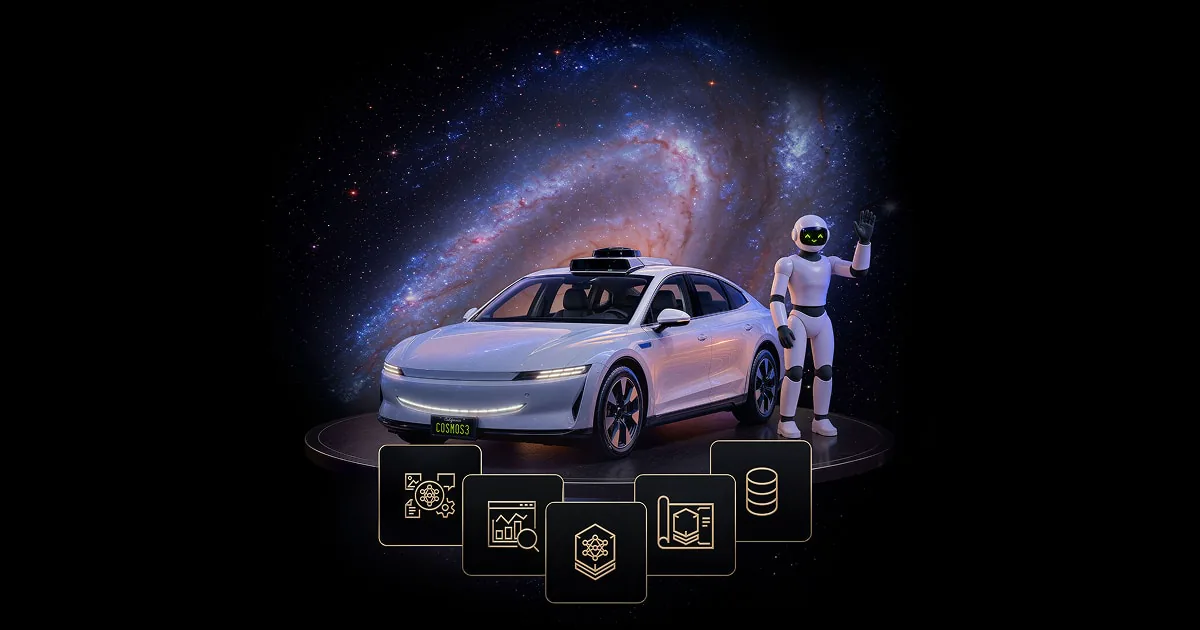
- The four checkpoints published to Hugging Face all represent 16-billion parameter Cosmos 3 Nano post-training variants (8B reasoner + 8B generator), not separate model sizes.
- The broader Cosmos 3 architecture encompasses a 64B parameter Super variant, designed for high-end robotics simulation clusters rather than local edge deployment.
- Weights are distributed under NVIDIA’s Open Model Developer Workshop (OpenMDW) 1.1 license rather than permissive Apache 2.0, establishing distinct commercial redistribution terms.
Model taxonomy: Deconstructing the 4 Hugging Face Nano 16B checkpoints
NVIDIA’s deployment of the Cosmos 3 foundation model suite across Hugging Face has triggered substantial discussion across robotics and physical AI communities. However, popular aggregation blogs have misrepresented the release by reporting that NVIDIA launched four distinct foundation models of varying scales. Technical inspection of repository metadata confirms that all four downloadable checkpoints are specialized post-training configurations of Cosmos 3 Nano (16B).
The Nano architecture operates as a composite dual-module framework comprising an 8-billion parameter multimodal spatial reasoner coupled to an 8-billion parameter dynamic action generator. The four repository variants correspond to distinct post-training alignments—optimized respectively for robotic manipulation trajectories, visual autonomous navigation, physics prediction, and synthetic world generation.
Cosmos 3 Super (64B): The cluster-grade flagship model
In technical documentation accompanying the release, NVIDIA outlines the complete architectural hierarchy of Cosmos 3, revealing that the flagship model is Cosmos 3 Super, featuring 64 billion total active parameters. Cosmos 3 Super is engineered to run across multi-GPU Blackwell clusters to simulate high-fidelity interactive physical worlds, train synthetic data generators, and validate complex autonomous driving edge cases.
Unlike Cosmos 3 Nano, which can run locally on high-end desktop workstations equipped with 24GB to 32GB of VRAM (such as RTX 4090 or RTX 5090 GPUs using INT4 quantization), Cosmos 3 Super demands multi-node enterprise infrastructure, positioning it as an industrial research asset rather than an edge deployment solution.
Legal terms and deployment: Understanding the OpenMDW 1.1 license
Engineers planning commercial integration must carefully examine the governing distribution agreement. NVIDIA released Cosmos 3 under the Open Model Developer Workshop (OpenMDW) Version 1.1 License, rather than standard Apache 2.0 or MIT terms. While OpenMDW 1.1 grants royalty-free rights to use, modify, and fine-tune model weights for commercial products, it mandates strict attribution, prohibits using outputs to train competing proprietary foundation models, and requires enterprise licensees with substantial annual revenue to adhere to compliance audits.
For robotics teams seeking open physical AI infrastructure, Cosmos 3 Nano provides unprecedented spatial simulation capabilities when paired with NVIDIA Isaac Sim environments.
Sources: NVIDIA Cosmos Foundation Model Suite on Hugging Face|NVIDIA ↗ NVIDIA Cosmos World Foundation Model Platform|NVIDIA Developer ↗
THE BROADER CONTEXT · FRONTIER LABS DOSSIER
Explore full product specifications, pricing analysis, and continuous coverage in the Frontier Labs Desk Hub and Others Dossier. Independent benchmarks available on the AI Intelligence Index and Coding Agents Leaderboard.