Google Antigravity Launches Dynamic Workflows (/run-workflow) for Scripted Parallel and Sequential Subagents
Available on Google AI Pro and Ultra in both the Antigravity App and CLI, /run-workflow writes inspectable Python scripts using parallel() and pipeline() to orchestrate Gemini 4 Hydrogen and Carbon.
THE STORY IN THREE POINTS
- Dynamic Workflows (/run-workflow) launched across the Antigravity App and Antigravity CLI for Google AI Pro and Google AI Ultra subscribers, generating Python 3.8+ orchestration scripts with parallel() and pipeline() primitives.
- Subagents run in isolated conversations with JSON Schema finish validation, configurable model tiers (inherit, flash_lite, flash, pro), custom subagent types, and isolated branch/share workspaces.
- Users inspect and approve exact generated scripts before execution (or save reusable .py flows), while Google DeepMind’s Varun Mohan notes models will soon invoke dynamic workflows autonomously across Hydrogen and Carbon.
Deterministic Python orchestration with parallel(), pipeline(), and JSON schemas
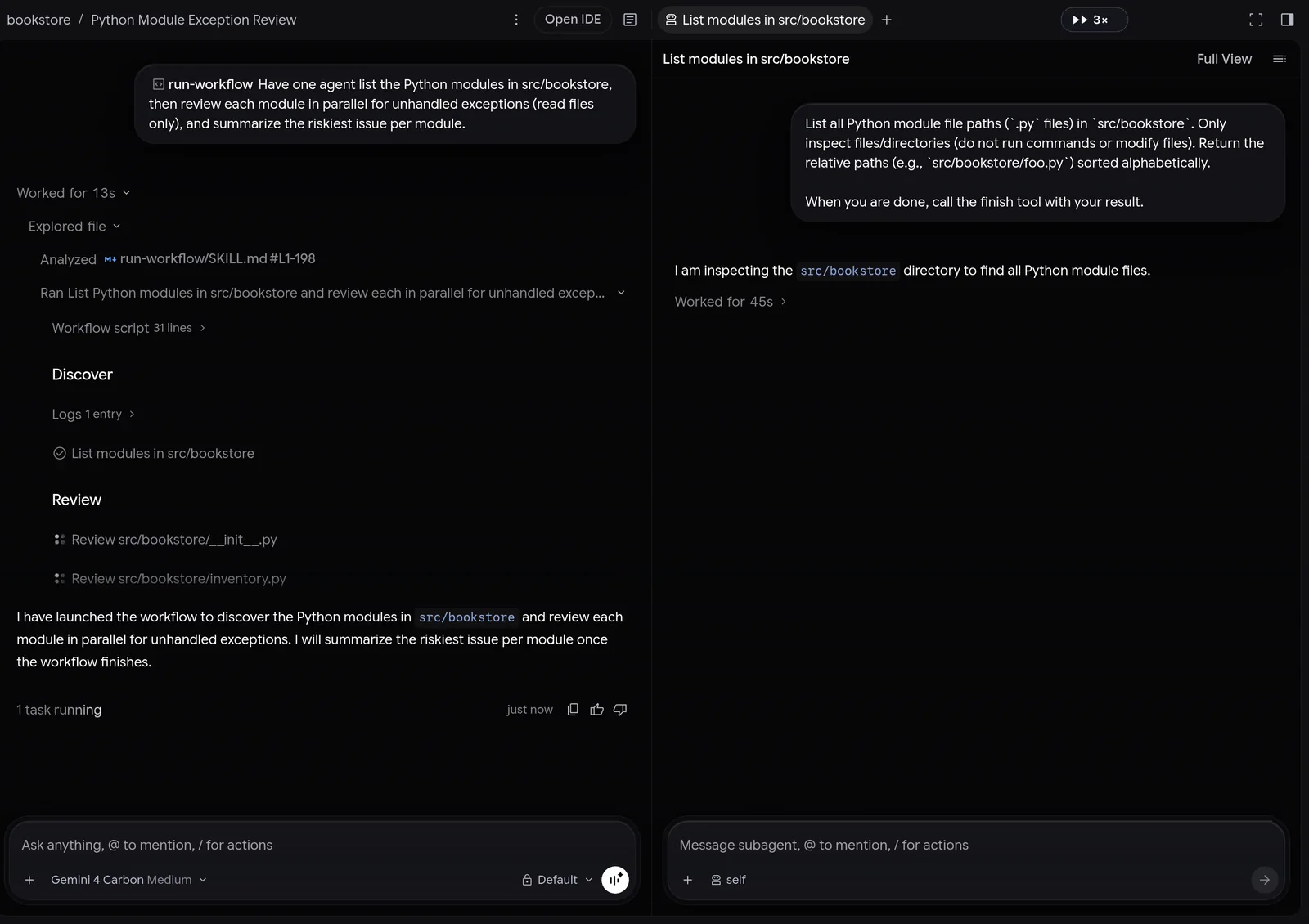
Unveiled by @antigravity on November 13 (19:41 UTC) alongside commentary from Google DeepMind engineering leader Varun Mohan (@_mohansolo, 19:52 UTC), Dynamic Workflows adds deterministic code-driven orchestration to Google Antigravity. Rather than stretching one conversation until tool logs overwhelm context, typing /run-workflow or describing a multi-part job prompts the coordinator to invoke the built-in run-workflow skill and author a Python script tailored to the task.
Inside the script, developers can combine named phase() stages, concurrent parallel() fan-outs (canceling remaining siblings if one fails), sequential pipeline() loops, await trajectory() lookups against prior turns, and structured JSON Schema contracts enforced when each worker calls its finish tool. Each spawned subagent works cleanly in an isolated transcript so verbose file reads and test logs never pollute the primary chat.
Routing Hydrogen and Carbon, review-before-run gates, and autonomous triggers ahead
Script authors and prompts can mix speed and frontier reasoning by setting per-agent model tiers (inherit, flash_lite, flash, or pro), targeting read-only research or custom subagents via type_name, and isolating concurrent editors via Git worktree branch or share workspaces. Mohan highlighted heavy internal adoption specifically for pairing Gemini 4 Hydrogen and Carbon within programmatic workflows, noting that models should soon decide on their own when to spin up workflows—mirroring Antigravity’s autonomous /swarm trigger.
Before execution begins (unless Turbo or matching presets bypass prompts), Antigravity surfaces the exact Python file in an Allow running this workflow script? confirmation dialog—approvals bind strictly to that exact script rather than broad command-prefix wildcards, and Antigravity bundles its own Python 3.8+ runtime (overridable via ANTIGRAVITY_PYTHON). Proven scripts can be committed to a project and re-invoked anytime with prompts such as /run-workflow Run scripts/review-changes.py.
How Dynamic Workflows fits beside Orchestrator, /swarm, /boost, and /teamwork
Live progress renders inline in the App as expandable phase cards (clickable to inspect or approve subagent tool calls directly) and in the Antigravity CLI via Ctrl+O tree expansion. Google now positions Dynamic Workflows as the middle architectural tier between single-thread Orchestrator routing (Carbon/Argon delegating to Hydrogen) and peer-to-peer message boards under /swarm.
Teams migrating automated tasks before the year-end Google Jules shutdown can choose /run-workflow whenever tasks need repeatable per-file audits, staged write-test-then-fix loops, and strict JSON handoffs without peer chatter.
Sources: Google Antigravity Dynamic Workflows Rollout (@antigravity)|X ↗ Varun Mohan on Dynamic Workflows Orchestrating Hydrogen and Carbon (@_mohansolo)|X ↗ Dynamic Workflows (/run-workflow) Documentation|Google Antigravity Docs ↗
THE BROADER CONTEXT · GOOGLE DOSSIER
Explore full product specifications, pricing analysis, and continuous coverage in the Google Desk Hub. Independent benchmarks available on the AI Intelligence Index and Coding Agents Leaderboard.