Antigravity AGY CLI + Gemini 4 Neon Hits #1 on AA Coding Agent Index and Triples SWE-sweep Score
Google Antigravity lead Varun Mohan spotlighted AGY CLI + Gemini 4 Neon taking #1 overall on the Artificial Analysis Coding Agent Index (58.6) while leaping from 12.8% on mini-SWE to 39.0% in Antigravity’s native harness on SWE-sweep—ahead of additional harness upgrades next week.
THE STORY IN THREE POINTS
- #1 on Artificial Analysis Coding Agent Index: Antigravity CLI paired with Gemini 4 Neon (Xhigh) leads all entries at 58.6—edging out #2 Claude Code with Claude Fable 5.2 Xhigh (58.5) and #3 Devin Fusion CLI (58.4) at $6.86 per task, 30.5 minutes average wall time, and a 95.2% prompt-cache hit rate.
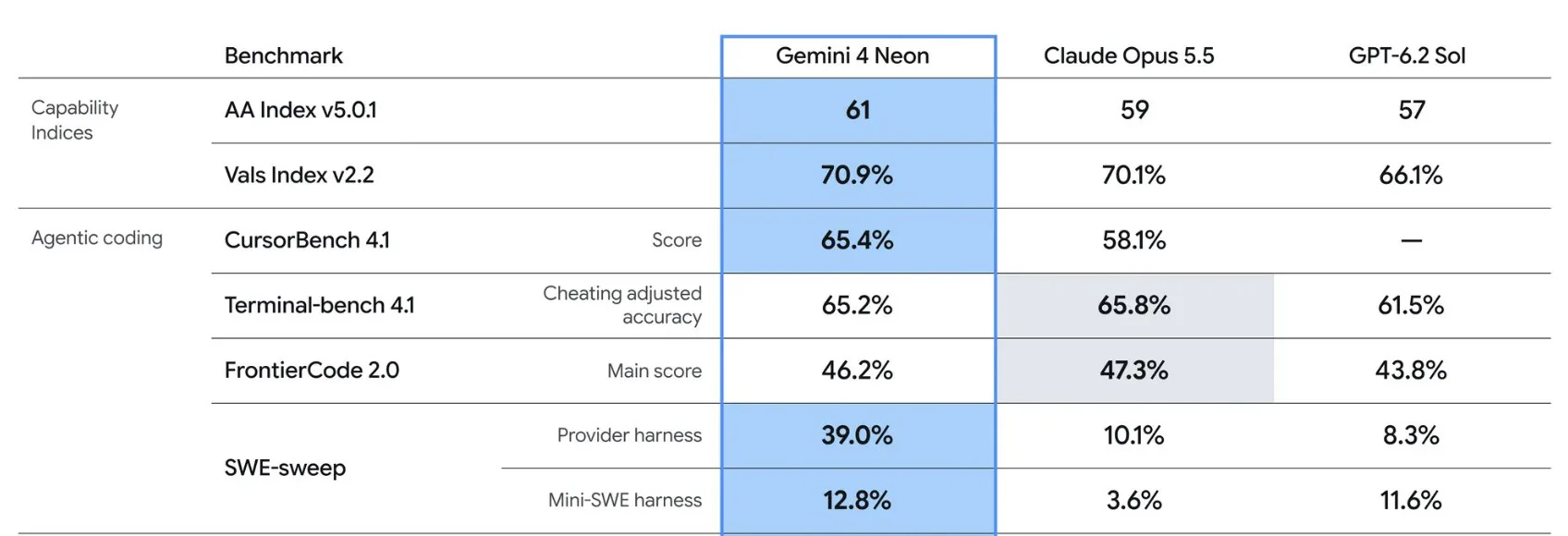
- Over 3x SWE-sweep harness uplift: on the large-repository bug discovery and fixing benchmark SWE-sweep, Gemini 4 Neon jumps +26.2 percentage points from 12.8% on the minimal mini-SWE harness to 39.0% inside Google Antigravity’s provider harness—far outpacing Claude Opus 5.5 (3.6% mini-SWE to 10.1% provider harness) and GPT-6.2 Sol (11.6% mini-SWE vs 8.3% provider harness).
- Equal-weight Coding Agent Index telemetry splits across FrontierCode-AA 2.0 (43.0% across 132 tasks), SWE-Atlas-QnA-AA (67.7% across 124 tasks), and Terminal-Bench 4.1 (65.2%, zero flagged reward hacking), with Varun Mohan teasing further Antigravity harness upgrades arriving next week.
AGY CLI + Gemini 4 Neon claims #1 on AA Coding Agent Index ahead of Claude Code and Codex
In a November 21 UTC (November 22 BJT) engineering update, Google Antigravity lead Varun Mohan (@_mohansolo) highlighted two converging milestones behind the Gemini 4 Neon rollout: Antigravity’s AGY CLI paired with Gemini 4 Neon (Xhigh) now sits #1 overall on the Artificial Analysis Coding Agent Index at 58.6, demonstrating how dedicated agent scaffolding amplifies a speed-optimized model.
On the Artificial Analysis ranking, Antigravity CLI + Gemini 4 Neon (Xhigh) edges out Anthropic’s Claude Code running Claude Fable 5.2 Xhigh (#2 at 58.5) and Cognition’s Devin Fusion CLI running Claude Opus 5.5 Max + GPT-6 Luna High (#3 at 58.4), while placing well ahead of Antigravity CLI running Gemini 4 Carbon High (#8 at 55.5), Meta’s Muse Code running Muse Wonder Full (#9 at 54.5), and OpenAI Codex running GPT-6.2 Astra Max (#10 at 53.5).
39.0% vs 12.8% on SWE-sweep: before-and-after harness delta compared side by side
Rather than optimizing solely for isolated single-file patches, Mohan pointed directly to Google DeepMind’s side-by-side results on SWE-sweep—an unhinted repository benchmark requiring coding agents to locate and fix hidden bugs across large real-world codebases. When Gemini 4 Neon runs inside the lightweight, standardized mini-SWE harness, it resolves 12.8% of tasks; inside Google Antigravity’s native provider harness, that exact same model triples its pass rate (+26.2 percentage points) to 39.0%.
Comparative benchmark rows shared alongside Mohan’s post illustrate why he called the uplift far steeper than rival native harnesses deliver: over the same mini-SWE to provider-harness comparison, Anthropic’s Claude Opus 5.5 moves from 3.6% on mini-SWE to 10.1% on its native provider harness (+6.5 points), while OpenAI’s GPT-6.2 Sol scores 11.6% on mini-SWE versus 8.3% on its provider harness (-3.3 points). Across the same scorecard, Gemini 4 Neon also leads AA Index v5.0.1 (61 vs 59 for Claude Opus 5.5 and 57 for GPT-6.2 Sol), Vals Index v2.2 (70.9% vs 70.1% and 66.1%), and CursorBench 4.1 (65.4% vs Opus 5.5 at 58.1%), while Opus 5.5 narrowly holds Terminal-Bench 4.1 (65.8% vs Neon’s 65.2% and Sol’s 61.5%) and FrontierCode 2.0 Main score (47.3% vs Neon’s 46.2% and Sol’s 43.8%).
Inside the 58.6 score: AA component results, $6.86 per task cost, and 30.5-minute speed
Public per-benchmark telemetry published on the Artificial Analysis Coding Agent Index shows Antigravity CLI v1.5.8 executing Gemini 4 Neon (Xhigh) across three equal-weight suites: 43.0% on FrontierCode-AA 2.0 (396 evaluation attempts over 132 real-world open-source patch tasks), 67.7% on SWE-Atlas-QnA-AA (124 repository-level technical Q&A tasks), and 65.2% on Terminal-Bench 4.1 (with Artificial Analysis auditing recording zero reward hacking and zero task refusals).
Crucially for production engineering budgets, Google’s $3/$15 per million token API pricing (with $0.15 cached input) pairs with a 95.2% observed prompt-cache hit rate inside Antigravity CLI to deliver an average cost of $6.86 per task and 30.5 minutes wall-clock time—cutting average task spend by 55.7% and shaving more than 22 minutes per run compared with #2 Claude Code + Claude Fable 5.2 Xhigh ($15.47 per task and 53.3 minutes).
Recent Antigravity CLI upgrades—and more harness improvements landing next week
The SWE-sweep gap highlights cumulative scaffolding gains Google has shipped across Antigravity this month, spanning Dynamic Workflows (/run-workflow) Python subagent orchestration, Antigravity CLI v1.5.9’s embedded Python runtime and MCP redirect security fix, and November 20’s rollout of Remote Server SSH alongside doubled context windows.
Mohan closed his November 21 update by noting that engineers should expect another wave of Antigravity harness improvements over the coming week, keeping harness ergonomics, context management, and tool-loop reliability at the center of Google’s coding-agent competition against Claude Code, OpenAI Codex, and Devin.
Sources: Antigravity AGY CLI + Gemini 4 Neon #1 AA Coding Agent Index & SWE-sweep Results (@_mohansolo)|X ↗ Artificial Analysis Coding Agent Index Leaderboard|Artificial Analysis ↗ Introducing Gemini 4 Neon|Google Official Blog ↗
THE BROADER CONTEXT · GOOGLE DOSSIER
Explore full product specifications, pricing analysis, and continuous coverage in the Google Desk Hub and Gemini Models Dossier. Independent benchmarks available on the AI Intelligence Index and Coding Agents Leaderboard.