Google Releases A2UI 1.0: Open Agent-to-UI Protocol, MCP Apps & Decision Model UI
Google open-sources stable A2UI 1.0 under Apache 2.0 with bidirectional function calls, native React/Flutter/SwiftUI renderers, and early adoption at Atlassian, Bloomberg, and Alation.
THE STORY IN THREE POINTS
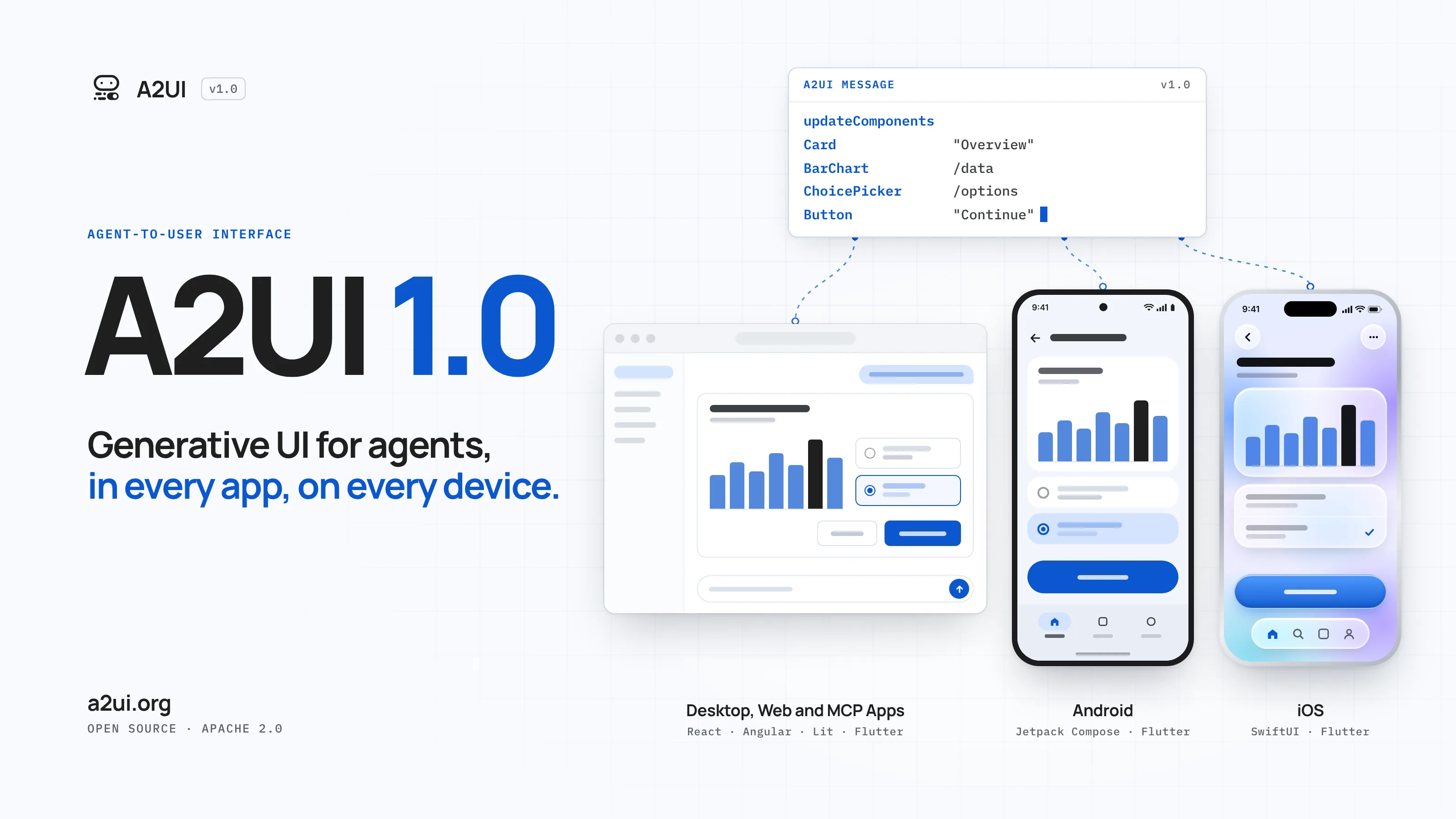
- A2UI 1.0 launches on November 11, 2026 as a stable Apache-2.0 open specification letting AI agents return native interactive UI screens instead of walls of plain text.
- Version 1.0 adds bidirectional function calls for live availability lookups, accessibility support, web/Flutter/SwiftUI renderers (Jetpack Compose 1.0 coming soon), and Agent SDKs for Python, TypeScript, and Dart.
- Because A2UI restricts agents to registered host design-system components and binds sensitive data server-side, web and Flutter views embed safely inside MCP Apps hosts such as Gemini and Claude.
Breaking the wall-of-text era with bidirectional function calls
Announced on November 11, 2026 by Google’s A2UI team, A2UI 1.0 graduates from preview into a stable Apache-2.0 open standard for Agent-to-User Interfaces. Rather than emitting untrusted HTML or forcing users through repetitive text confirmations when coordinating calendars, bookings, and multi-app approvals, agents stream declarative A2UI payloads describing components that host applications render natively at device speed.
Version 1.0 introduces bidirectional function calls—allowing a flight picker or appointment selector inside the generated UI card to query live inventory without regenerating the whole conversation turn—alongside formal accessibility attributes and extension metadata. Companion Agent SDKs for Python (including programmatic A2UI Macros), TypeScript, and Dart automate schema validation, message translation, and syntax error recovery across diverse model harnesses.
Native React, Flutter, SwiftUI renderers, MCP Apps and Decision-1 speed
Open-source client renderers cover React, Angular, and Lit on the web; Flutter across mobile, web, and desktop; and SwiftUI on iOS at v1.0, while Jetpack Compose on Android operates at v0.9.1 ahead of an upcoming v1.0 upgrade. Crucially, the web and Flutter renderers plug directly into MCP Apps hosts, letting enterprise agents project interactive branded workflows inside third-party assistants including both Gemini and Claude.
To cut UI assembly latency, A2UI pairs A2UI Express with ultra-fast prefill "system one" decision models—explicitly naming Jev alongside workflows comparable to Gemini Decision-1 prefill scoring—so models select and bind host components deterministically rather than decoding verbose markup tokens.
Server-side data binding and early production deployments
Security teams frequently reject generative UI frameworks that allow models to execute arbitrary client JavaScript or leak customer fields through model context. A2UI enforces strict host ownership: agents may only instantiate components explicitly whitelisted in the organization’s design system, while server-side binding hydrates sensitive values into child components without exposing raw fields back to the LLM.
Production adoption already spans Atlassian, Alation (streaming A2UI feeds inside Claude via MCP Apps), Bloomberg, and ByteDance, alongside internal Google products such as Gemini Notebook option cards and Gemini Enterprise (currently at 0.9.1 with a v1.0 upgrade underway).
Sources: A2UI 1.0: Build delightful, fast, reliable, agentic experiences|Google Developers Blog ↗ A2UI Open Protocol Documentation & SDKs|a2ui.org ↗
THE BROADER CONTEXT · GOOGLE DOSSIER
Explore full product specifications, pricing analysis, and continuous coverage in the Google Desk Hub. Independent benchmarks available on the AI Intelligence Index and Coding Agents Leaderboard.