Endless Frontier Releases Fx-Bio-1031 Bioinformatics Model Claiming 70.59% on BioMysteryBench Difficult
The 180B-total / 6B-active Qwen3.8-Flash-Next fine-tune ships under Qwen Community License 1.0 with 524K context—requiring clear separation between internal Pass@5 evaluations and audited leaderboards.
THE STORY IN THREE POINTS
- Endless Frontier released Fx-Bio-1031 (checkpoint 20261009-r2/iter_0001384, Oct 31 weights ~360 GB across 73 BF16 shards) built on Qwen3.8-Flash-Next with 180B total storage, 6B active parameters, 524,288 context, and Qwen Community License 1.0.
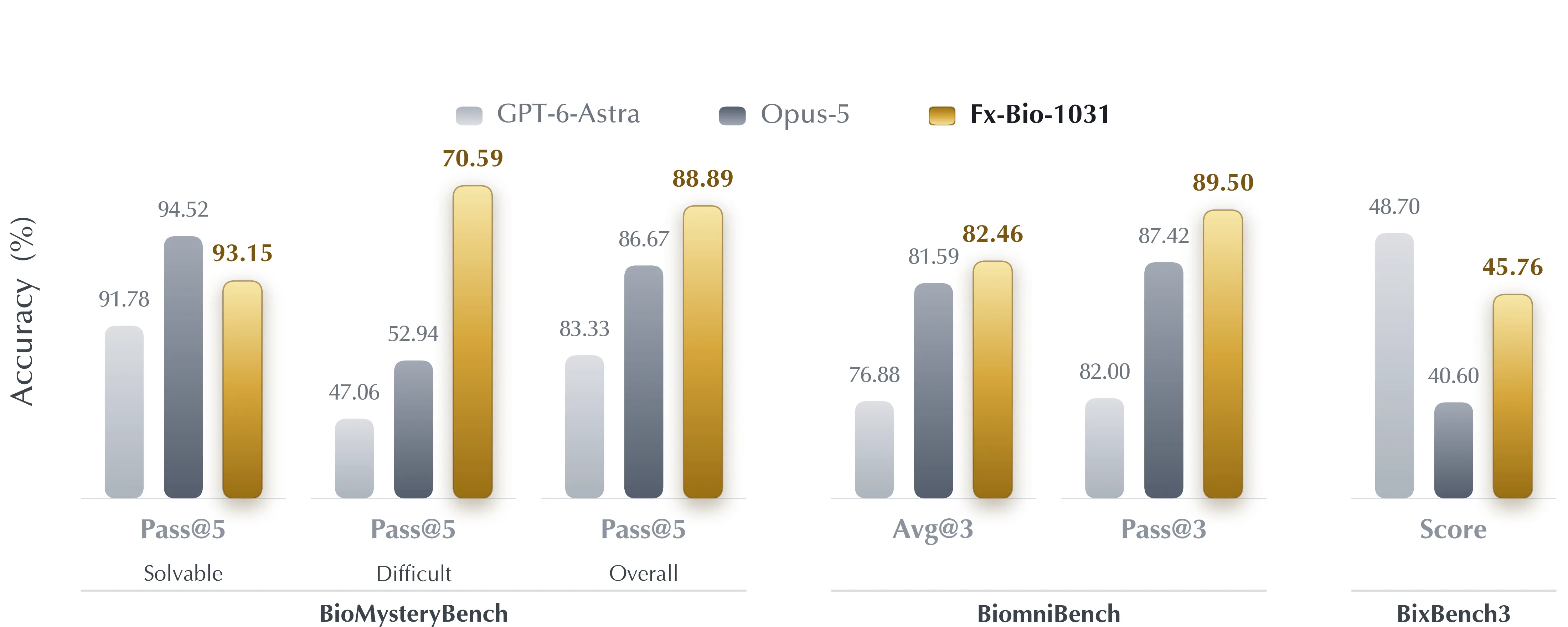
- Inside Endless Frontier’s own agentic evaluation harness, Fx-Bio-1031 claims 70.59% Pass@5 on BioMysteryBench Difficult and 88.89% Overall Pass@5, alongside 82.46 Avg@3 (89.50 Pass@3) on BiomniBench and 45.76 on BixBench3.
- Because the BioMysteryBench numbers are self-reported Pass@5 multi-attempt scores run against an internal Opus-5 baseline—not independent single-shot Pass@1 evaluations—research teams should treat the claim as provisional until reproduced.
180B-total / 6B-active Qwen3.8-Flash-Next layout and Qwen Community License 1.0
Endless Frontier has open-weighted Fx-Bio-1031, a domain-specialized bioinformatics reasoning model uploaded on Hugging Face across 73 BF16 shards totaling roughly 360 GB (checkpoint 20261009-r2/iter_0001384, dated October 31 and highlighted in QbitAI and Pandaily coverage on November 13–14). Under the hood, the checkpoint inherits the Qwen4ExpForConditionalGeneration architecture of Qwen3.8-Flash-Next with a 524,288-token (512K) context window across 48 layers.
The 180B headline weight footprint reflects three distinct components: a 125B Mixture-of-Experts backbone activating just 6B parameters per token (10 of 512 routed experts plus 1 shared expert), paired with a 51B n-gram embedding table and a 4B Multi-Token Prediction (MTP) module. Crucially for biotech startups checking compliance, Hugging Face metadata confirms the checkpoint is governed by the custom Qwen Community License 1.0 inherited from Qwen3.8-Flash-Next rather than Apache 2.0 or MIT, placing it in the non-OSI tier tracked in our open-weight license matrix.
Self-reported BioMysteryBench Difficult 70.59% vs Opus-5 and GPT-6-Astra
Anthropic originally introduced BioMysteryBench on April 29, 2026 as a 99-question bioinformatics detective benchmark—including 76 human-solvable research puzzles spanning genomics, proteomics, and sequencing anomalies—with the gated Anthropic/BioMysteryBench-full repository governed by CC BY 4.0 plus non-training rules to prevent contamination.
Evaluating inside its own internal agentic tool-use harness, Endless Frontier reports 93.15% Solvable Pass@5 for Fx-Bio-1031 (compared against vendor-run baselines of 94.52% for Opus-5 and 91.78% for GPT-6-Astra), 70.59% on the BioMysteryBench Difficult slice (ahead of 52.94% for Opus-5 and 47.06% for GPT-6-Astra in the same table), and 88.89% Overall Pass@5 (vs 86.67% for Opus-5 and 83.33% for GPT-6-Astra). On secondary biology suites, Endless Frontier cites 82.46 Avg@3 and 89.50 Pass@3 on BiomniBench, and 45.76 on BixBench3 (between GPT-6-Astra’s 48.70 and Opus-5’s 40.60).
Pass@5 vs Pass@1: Why independent verification remains missing
Computational biologists assessing Fx-Bio-1031 should separate multi-sample research potential from single-run laboratory reliability. Pass@5 credits a model whenever at least one of five independent agent trajectories solves a mystery task—substantially boosting headline percentages over single-shot Pass@1 accuracy and amplifying differences in tool orchestration, retry handling, and Python/R execution sandboxes.
Furthermore, Endless Frontier’s comparison chart pairs Fx-Bio-1031 against vendor-executed Opus-5 rather than Anthropic’s newer Opus 5.5 checkpoint, and Anthropic has not published an external audit of the Fx-Bio-1031 run. Teams evaluating the ~360 GB weights should run blinded in-house bioinformatics suites before replacing proprietary frontier models.
Sources: endless-frontier/Fx-Bio-1031 Model Card & Weights|Hugging Face ↗ Endless Frontier Open-Sources Fx-Bio-1031 Bioinformatics Agent Model|Pandaily ↗ Fx-Bio-1031 Report & Technical Breakdown|QbitAI ↗ Evaluating Claude for Bioinformatics with BioMysteryBench|Anthropic Research ↗ Anthropic/BioMysteryBench-full Gated Evaluation Dataset|Hugging Face ↗
THE BROADER CONTEXT · FRONTIER LABS DOSSIER
Explore full product specifications, pricing analysis, and continuous coverage in the Frontier Labs Desk Hub and Others Dossier. Independent benchmarks available on the AI Intelligence Index and Coding Agents Leaderboard.