DeepSeek V4.1 Flash on Artificial Analysis v5: FrontierCode 2.0 and Open-Weight Benchmarks
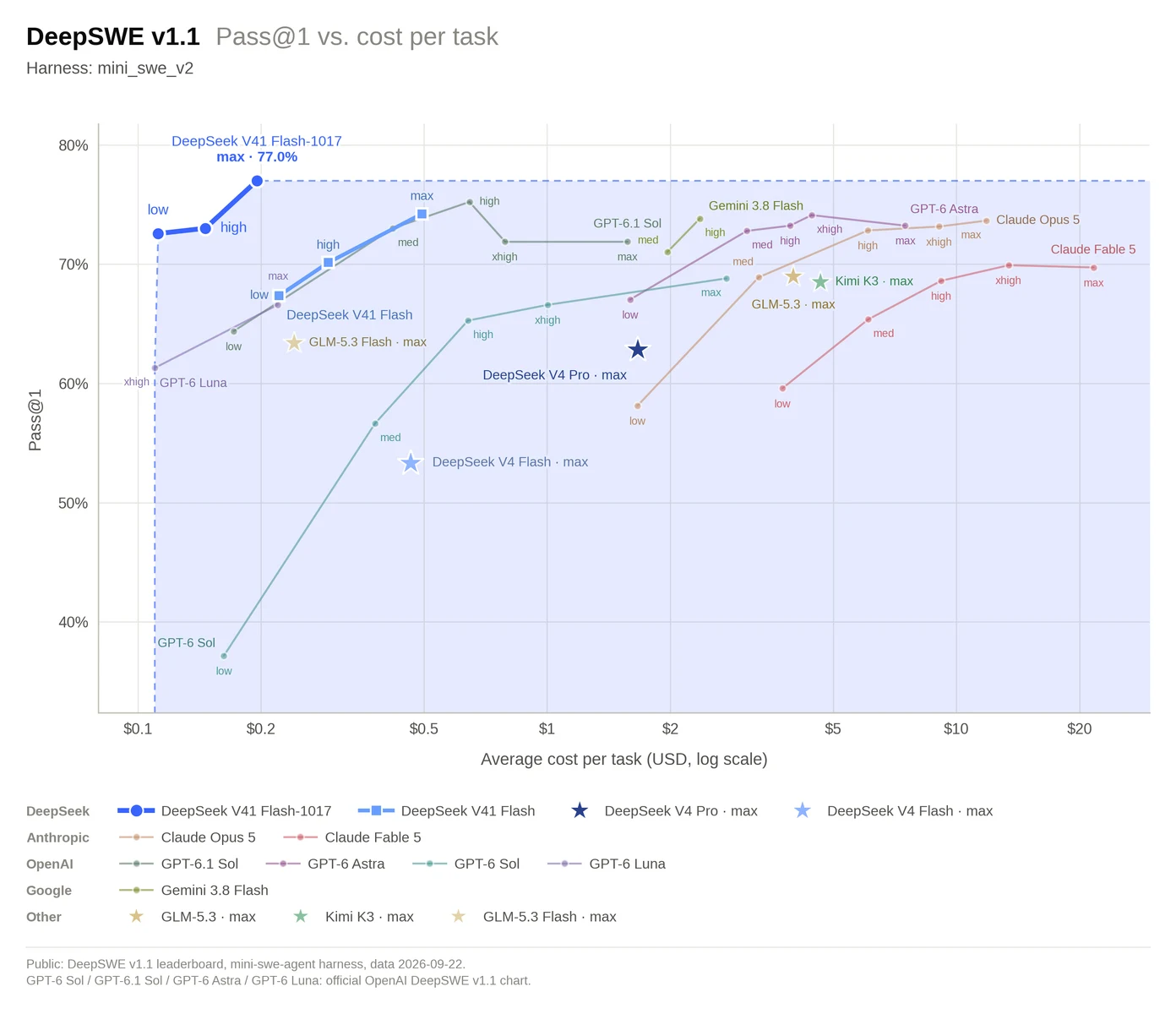
On Artificial Analysis Intelligence Index v5, DeepSeek V4.1 Flash (checkpoint 1017) scores 32 (and 33 on v5.0.1 Max), tying GLM-5.3 on initial v5 open-weight snapshots while new evaluation rubrics widen the gap to proprietary leaders.
THE STORY IN THREE POINTS
- DeepSeek V4.1 Flash (checkpoint 1017) scored 32 on the initial Intelligence Index v5 open-weight snapshot (matching GLM-5.3 at 32) and reached 33 under v5.0.1 Max reasoning.
- The v5 methodology overhaul incorporated FrontierCode 2.0 (132 real repository tasks judged by maintainer merge criteria) and raised private held-out test suites to 60%.
- The updated evaluation framework widened the scoring delta between open-weight models and closed frontier flagships from 3 points in v4.3 to 12 points in v5.0.1.
Open-weight standings: DeepSeek V4.1 Flash and GLM-5.3 on Intelligence Index v5
The publication of Artificial Analysis Intelligence Index v5 and v5.0.1 provides rigorous comparative data for engineering teams evaluating open-weight deployments. On the initial v5 open-weight snapshot, DeepSeek V4.1 Flash (checkpoint 1017) and Zhipu AI’s GLM-5.3 achieved composite index scores of 32 (with DeepSeek V4.1 Flash 1017 Max reaching 33 on the updated v5.0.1 board). Both models outpaced earlier releases like DeepSeek V4 (28), while Mistral Large 4 registered a notable split between its self-reported model card evaluation (26) and Artificial Analysis’s hosted preview testing (38.4).
Meanwhile, Moonshot AI’s 2.8-trillion parameter Kimi K3.1 Pro recorded an index score of 46. While early v5 index snapshots still flagged Kimi K3.1 Pro as weights-pending prior to indexing Moonshot’s November 4 Hugging Face weight release (moonshotai/Kimi-K3.1-Pro, 1.35 TB MXFP4), its 14-point lead over 32-to-33 class models like DeepSeek V4.1 Flash reflects the massive hardware gap between compact high-throughput Flash checkpoints and multi-trillion parameter MoE flagships.
Methodological overhaul: FrontierCode 2.0 and Terminal-Bench-Science
Understanding why scores shifted dramatically across the v5 transition requires reviewing the benchmark’s updated evaluation harness. Version 5.0.1 retired several legacy benchmarks susceptible to synthetic data contamination, introducing FrontierCode 2.0 and Terminal-Bench-Science 0.1. FrontierCode 2.0 evaluates models across 132 real-world open-source software engineering problems, scoring solutions strictly on whether human project maintainers would merge the resulting pull requests.
Furthermore, Artificial Analysis expanded private, held-out evaluation sets to comprise approximately 60% of total composite scores. By testing models on unseen test cases with dynamic grading, the index penalizes architectures that overfit on public evaluation corpora.
The widening frontier gap: Analyzing open vs. proprietary divergence
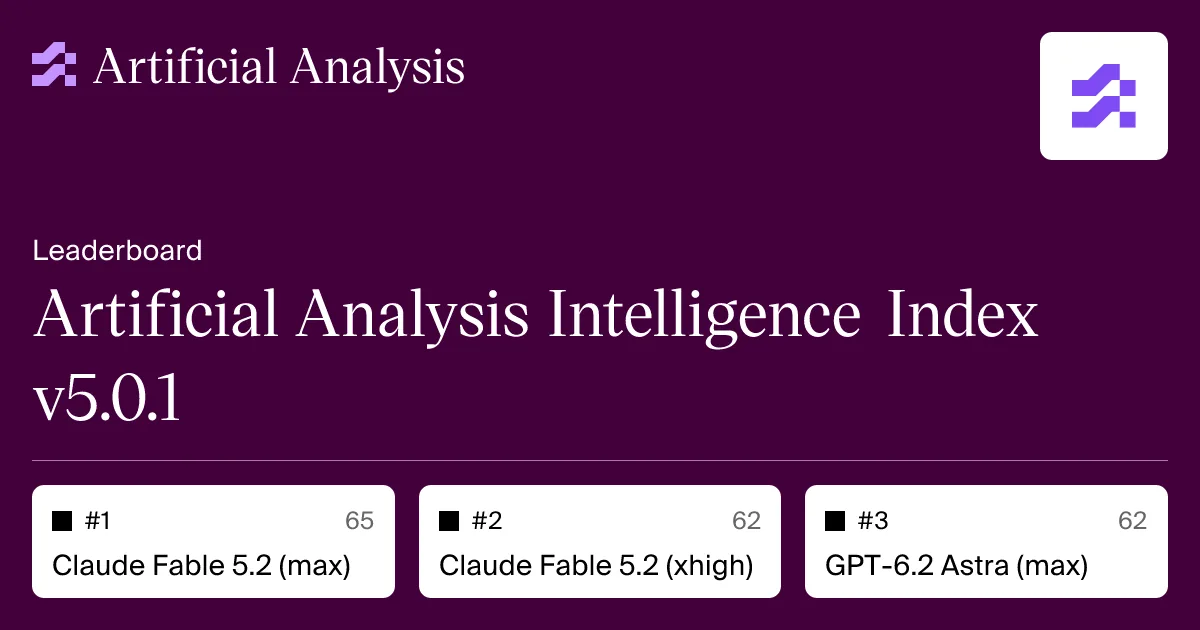
A prominent outcome of the v5.0.1 methodology is the widening performance gap between open-weight options and proprietary frontier offerings. Under v4.3 rubrics, leading open models trailed proprietary flagships by as little as 3 index points. Under v5.0.1, Claude Haiku 5.5 stands at 36, Claude Opus 5.5 reaches 59.1, and Claude Fable 5.2 Max commands the leaderboard at 65.
This establishes a 12-to-33 point performance divergence. For enterprise software architects, this quantitative disparity highlights that while DeepSeek V4.1 Flash delivers exceptional cost efficiency at scale, complex autonomous software engineering still demands frontier proprietary reasoning.
Sources: Intelligence Index v5.0.1 Model Rankings & Methodology|Artificial Analysis ↗ DeepSeek V4.1 Flash API Documentation & Model Card|DeepSeek AI ↗
THE BROADER CONTEXT · DEEPSEEK DOSSIER
Explore full product specifications, pricing analysis, and continuous coverage in the DeepSeek Desk Hub and DeepSeek Models Dossier. Independent benchmarks available on the AI Intelligence Index and Coding Agents Leaderboard.