CursorBench 4.0, GPQA Diamond and HLE: Evaluating Statistical Margins in Coding Evals
Examining software engineering benchmarks including CursorBench 4.0, GPQA Diamond, and Humanity’s Last Exam across confidence intervals and grader variance.
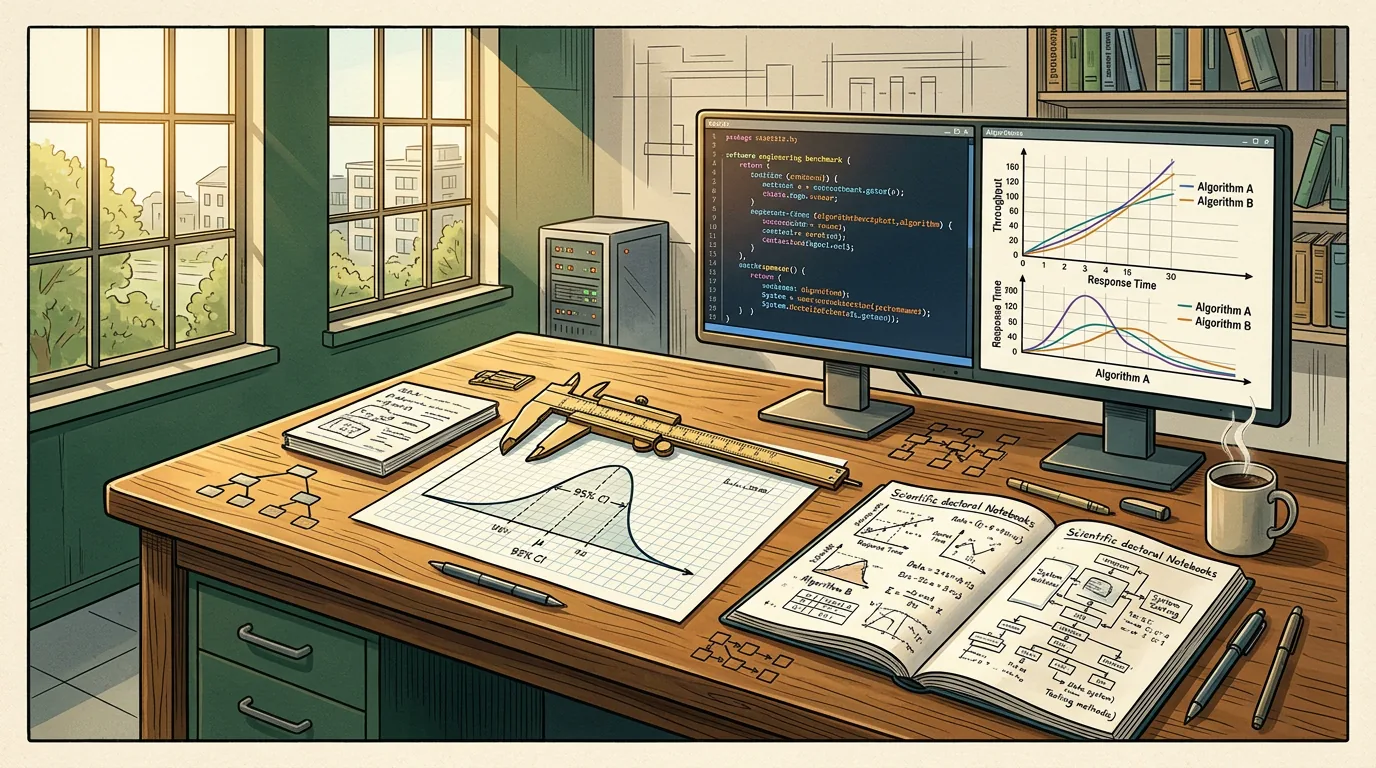
THE STORY IN THREE POINTS
- CursorBench 4.0 evaluations record Gemini 4 Carbon (High) at 60.4% and Claude Fable 5.2 (Max) at 60.0%, a 0.4% delta that falls well within statistical margin of error.
- On GPQA Diamond (graduate-level reasoning), leading models converge around 80–84%, requiring secondary multi-step benchmarks like Humanity’s Last Exam (HLE) to detect capabilities.
- Benchmarking methodology highlights that minor ranking changes frequently reflect prompt harness variations rather than intrinsic frontier capability shifts.
CursorBench 4.0 rankings: Why a 0.4% gap between Carbon and Fable is statistically insignificant
In software engineering evaluations, technical headlines frequently celebrate fractional lead changes on developer benchmarks. In early November 2026, updated CursorBench 4.0 leaderboards reported Google’s Gemini 4 Carbon (High effort) leading with a composite score of 60.4%, narrowly surpassing Anthropic’s Claude Fable 5.2 (Max effort) at 60.0% and Cursor Composer 2 baselines.
However, the benchmark documentation explicitly notes that a 0.4 percentage point separation across a finite evaluation sample lacks statistical significance. Across the complete six-tier official CursorBench 4.0 rankings, Carbon High reached 60.4% ($9.22 cost, 71 steps), Carbon Medium scored 60.1% ($8.49 cost, 67 steps), Claude Fable 5.2 Max achieved 60.0% ($32.79 cost, 218 steps), Claude Opus 5.5 Max recorded 57.8% ($13.43 cost, 185 steps), Carbon Low scored 58.6% ($11.89 cost, 124 steps), and Gemini 4 Argon High registered 52.9% ($4.57 cost, 118 steps).
Noticeably, Carbon Low ($11.89) incurs higher cost than Carbon Medium ($8.49) because it executed 124 iterative steps rather than 67 steps, demonstrating that lower effort tiers do not automatically guarantee cost savings. Furthermore, Google’s reported cost advantage relies heavily on initial introductory pricing of $2 input / $10 output; when standard list rates of $4 / $20 take effect on December 1, Carbon High’s cost advantage over Fable 5.2 Max narrows from approximately 3.6x to roughly 1.8x.
GPQA Diamond saturation: The shift toward Humanity’s Last Exam (HLE)
A broader methodological transition is occurring across foundational reasoning benchmarks. Long-standing evaluation suites like GPQA Diamond—composed of rigorous, expert-level scientific questions designed to resist web search lookups—are experiencing score saturation, with frontier reasoning models uniformly scoring between 80% and 84%.
To restore evaluation dynamic range, researchers are standardizing on Humanity’s Last Exam (HLE), an extraordinarily difficult multi-disciplinary examination encompassing mathematics, biology, cryptography, and computer systems. On HLE evaluated with tool access, Claude Fable 5.2 registered 74.2% while Claude Opus 5.5 achieved 67.7%, demonstrating clear differentiation on frontier reasoning frontiers.
Avoiding benchmark illusions: Grader variance, harness shifts, and reproducible scores
Ensuring reproducible model evaluations requires auditing grader prompts and system instructions. Minor variations in AST-based code parsers, test runner timeouts, or container sandboxes can introduce swings of 3% to 5% across identical model weights.
Engineering teams should evaluate models using composite indexes rather than isolated scores. Review comprehensive index methodology in our Artificial Analysis Index versions guide and inspect IDE integrations in Grok Build vs Cursor Composer analysis.
Sources: CursorBench 4.0 Official Coding Agent Leaderboard & Test Suite|Cursor Evals ↗ Humanity’s Last Exam (HLE) Benchmark Results & Multi-Model Analysis|Center for AI Safety ↗ GPQA: A Graduate-Level Google-Proof Q&A Benchmark|arXiv ↗
THE BROADER CONTEXT · XAI DOSSIER
Explore full product specifications, pricing analysis, and continuous coverage in the xAI Desk Hub. Independent benchmarks available on the AI Intelligence Index and Coding Agents Leaderboard.