Google Antigravity Adds Gemini Live Voice Mode for Full-Duplex Coding Collaboration
Antigravity introduced Gemini Live voice pairing on November 7, enabling spoken collaboration with coding agents while team disclosures contrast active internal adoption with noisy-environment realities.
THE STORY IN THREE POINTS
- Antigravity introduced a native Gemini Live voice mode on November 7, 2026, allowing developers to speak directly with autonomous coding agents in full-duplex audio.
- Varun Mohan reported that multiple engineers across the internal team now build code predominantly through voice steering, using speech to guide architectural changes and triage test failures.
- Experiential boundaries: while voice dramatically accelerates high-level instruction and refactoring reviews, precise syntax tweaks and noisy office floors still require keyboard and terminal input.
Full-duplex speech pairing arrives in the agentic development environment
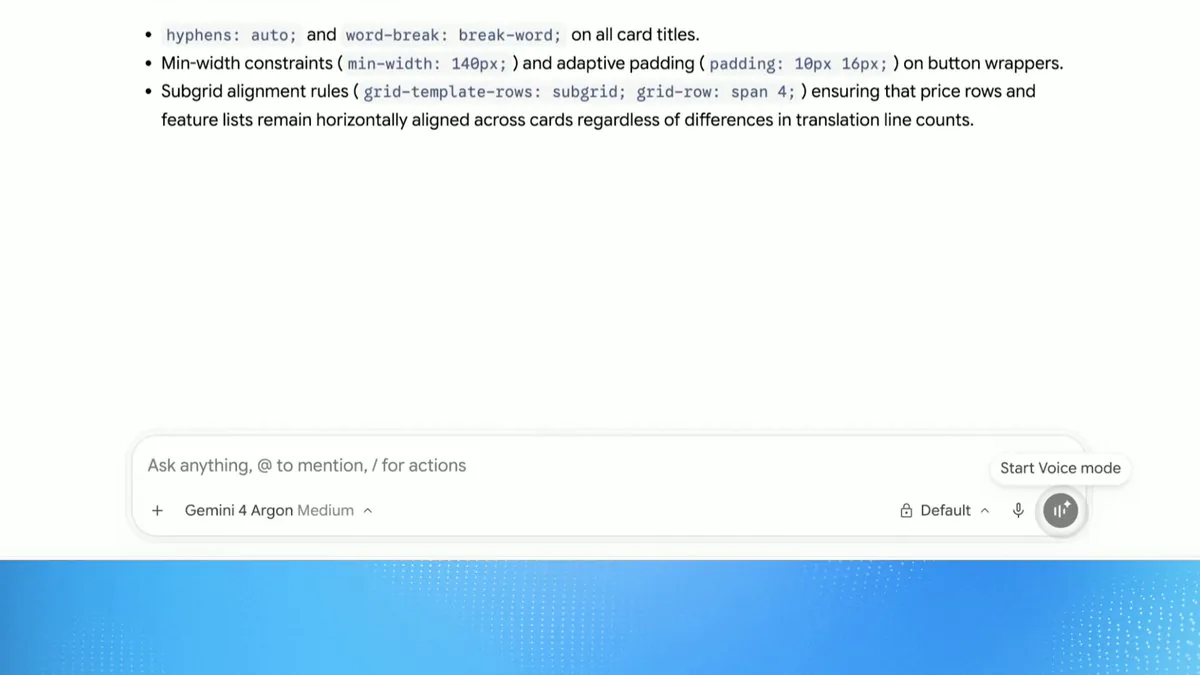
On November 7, 2026, Antigravity introduced a native voice collaboration mode powered by the Gemini Live streaming audio API. The rollout enables software engineers to converse naturally with the IDE’s autonomous coding agents in full-duplex audio, eliminating the requirement to context-switch away from code into a separate prompt input box.
Announced by Varun Mohan (@_mohansolo), the integration connects Antigravity directly to Gemini Live’s low-latency audio infrastructure. Developers can vocally narrate architectural refactors, review AST diffs in real time, and interrupt the assistant mid-explanation through natural barge-in without corrupting conversational state.
Talking to a coding agent: where voice excels and where it hits friction
The announcement provides a valuable opportunity to evaluate developer voice interaction, contrasting verified shipping features with personal usage observations. Mohan stated that many internal team members have shifted their primary workflow to voice-driven coding, using conversational steering to navigate complex repositories and guide automated test repairs.
In practice, vocal coding excels at coarse-grained cognitive direction: issuing high-level intentions such as "roll back the latest migration, check the SQLite write-ahead log constraints, and re-run pytest with verbose output." Spoken collaboration allows engineers to maintain flow while observing automated changes unfold across multiple split panes.
Acoustic boundaries, syntax precision and operational trade-offs
Despite internal enthusiasm, voice-driven programming encounters defined ergonomic limitations. Speech is poorly suited for fine-grained character edits, variable renames, and regular expressions, where phonetic ambiguity introduces unnecessary parsing round-trips.
Furthermore, acoustic interference in open-plan corporate offices remains a friction point. Antigravity mitigates background chatter through hardware echo cancellation and optional push-to-talk triggers, but the shipping reality remains a hybrid modality: vocal steering for high-level orchestration, paired with keyboard and terminal controls for precise code manipulation.
Sources: Varun Mohan (@_mohansolo) Antigravity Gemini Live voice announcement|X ↗ Gemini Live Developer API Documentation & Streaming Protocols|Google AI for Developers ↗
THE BROADER CONTEXT · GOOGLE DOSSIER
Explore full product specifications, pricing analysis, and continuous coverage in the Google Desk Hub. Independent benchmarks available on the AI Intelligence Index and Coding Agents Leaderboard.