SGLang vs vLLM: Prefix Caching, MoE Throughput & Setup
October 2026 releases reshape the two Apache-2.0 engines commanding roughly three-quarters of open-source inference: vLLM v0.32.0 adds NVFP4 KV caching and Model Runner V2, while SGLang v0.5.22 hits up to 2.3x H200 throughput on DeepSeek kernels.

THE STORY IN THREE POINTS
- Together vLLM (~45%–50% share, ~97K GitHub stars, default port :8000) and SGLang (~25%–30% share, ~38K–39K GitHub stars, default port :30000) account for roughly three-quarters of production open-weight inference under identical Apache 2.0 licenses.
- October 2026 milestones sharpen the choice: vLLM v0.32.0 makes Model Runner V2 default with NVFP4 KV-cache support across SM8x/SM90/SM12x and precompiled FlashInfer kernel downloads, while SGLang v0.5.22 ships InstantTensor (~10x faster cold loads) and DeepSeek DSpark/DSA optimizations reaching up to 2.3x H200 throughput.
- Choose SGLang when >60% of multi-turn agent, RAG, or RL rollout requests share prompt prefixes via RadixAttention; choose vLLM when broad 200+ model coverage, non-NVIDIA hardware plugins, or drop-in API compatibility come first.
Core specs and October 2026 releases: vLLM v0.32.0 vs SGLang v0.5.22
Because both serving engines ship major releases every two to three weeks, six-month-old SGLang vs vLLM benchmarks quickly miss decisive kernel upgrades. Per ClusterBid’s 2026 inference market report, vLLM (45%–50% adoption, ~97K GitHub stars, OpenAI-compatible default port :8000) and SGLang (25%–30% adoption, ~38K–39K stars, default port :30000) together cover roughly 75% of open-weight production deployments—both under permissive Apache 2.0 licenses.
Late-October releases pushed both stacks forward on opposite fronts. vLLM v0.32.0 retired legacy Model Runner V1 in favor of Model Runner V2 by default, introduced NVFP4 KV-cache compression across SM8x, SM90, and SM12x NVIDIA GPUs, and added vllm download-kernels to pull precompiled FlashInfer kernels cleanly at container build time. Meanwhile, SGLang v0.5.22 shipped its InstantTensor loader (~10x faster cold-start model loading), expanded piecewise CUDA graphs and ROCm/XPU images, and posted up to 2.3x per-GPU throughput gains on NVIDIA H200 (1.9x on AMD MI350X/MI355X) for DeepSeek sparse-attention workloads—complementing our earlier host-RAM offload analysis and DeepSeek DeepInfer coverage.
Hash-block Prefix Caching vs RadixAttention Tree in multi-turn agents and RL
The enduring architectural difference between the two runtimes sits in KV-cache reuse. vLLM built its reputation on PagedAttention block allocation and layers Automatic Prefix Caching (APC) on top of fixed-size hashed KV blocks. That delivers strong general-purpose throughput and keeps single-turn, unique-prompt benchmarks between both engines within roughly 5% of one another.
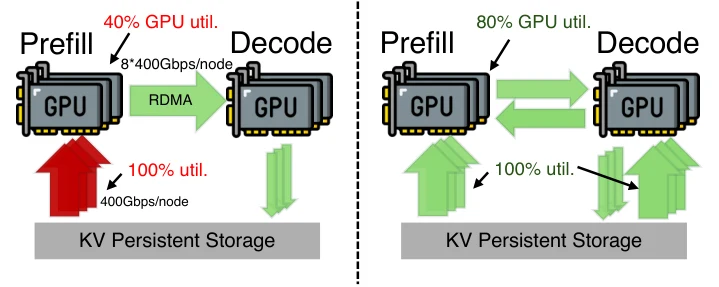
SGLang designs its entire scheduler around RadixAttention—organizing cached KV prefixes inside a dynamic radix tree rather than flat hash buckets. In multi-turn coding agents, shared-system-prompt RAG services, structured JSON decoding, and reinforcement-learning (RL) rollout clusters where >60% of requests overlap on common prefixes, RadixAttention reuses partial branches dynamically and pairs with SGLang’s upgraded Prefill-Decode disaggregation (cutting p95 time-to-first-token by up to half on long prompts in v0.5.22), making it the preferred default for high-overlap DeepSeek V4.1 clusters.
Hardware plugins, API compatibility, and practical setup guidelines
When raw prefix overlap is modest or infrastructure teams manage heterogeneous fleets, vLLM’s plugin maturity remains hard to beat. Supporting more than 200 model architectures alongside mature AMD ROCm, Intel Gaudi, AWS Trainium, and Google TPU plugins—plus native Anthropic Messages API compatibility and generic structured decision endpoints—vLLM lowers integration risk when serving mixed portfolios across DeepSeek V4/V4.1, Qwen, Llama, and Mistral checkpoints.
Operational selection follows a clean progression from our local-to-production scaling guide: prototype on Ollama or LM Studio for single-user development, deploy vLLM (:8000) as your default general-purpose multi-tenant GPU server across mixed model families, and benchmark SGLang (:30000) specifically for prefix-heavy agent loops, RL training rollouts, and H200/Blackwell DeepSeek MoE clusters where RadixAttention and DSpark kernels convert directly into lower GPU count.
Sources: vLLM Releases (v0.32.0 NVFP4 KV Cache & Model Runner V2)|GitHub ↗ SGLang Releases (v0.5.22 InstantTensor & H200 DeepSeek Kernels)|GitHub ↗ SGLang vs vLLM: Architecture, Versions & Throughput Comparison|Morph ↗ vLLM vs SGLang vs TensorRT-LLM vs NVIDIA Dynamo (2026 Market Report)|ClusterBid ↗
THE BROADER CONTEXT · DEEPSEEK DOSSIER
Explore full product specifications, pricing analysis, and continuous coverage in the DeepSeek Desk Hub and DeepSeek Models Dossier. Independent benchmarks available on the AI Intelligence Index and Coding Agents Leaderboard.