Gemini 4 Argon Review: Coding Benchmarks, Limits & Neon
Independent Gemini 4 Argon review: #1 IOI and 91.9% Vibe Code Bench highs vs. 19.6% legal agent limits, 40.39s TTFT responsiveness, Artificial Analysis v5.0.1 scores (50 High), and how it sits beside Carbon, Hydrogen, and Gemini 4 Neon.
THE STORY IN THREE POINTS
- Split benchmark profile: Gemini 4 Argon ranks #1 of 47 on IOI, scores 91.9% on Vibe Code Bench, #6 on the Vals Index (67.37%), and #4 Multilingual on BenchLM (79.1/100)—yet hits only 19.6% on Harvey Legal Agent and 26% on FrontierCode 2.0.
- Standings and lineup shift: Argon (Sept 30 cyber preview / Oct 13 GA at $2/$10) scores 50 High (48 Medium) on AA Intelligence Index v5.0.1, 45.5 Coding Agents Index, 1,529±5 Text Arena, and 1,681±9 WebDev Arena, though Gemini 4 Neon (Nov 18) replaced it as default in the consumer Gemini app.
- Latency edge over Opus 5.5: in Nov 5 Artificial Analysis tests (Emergent), Argon High returns its first token in 40.39 seconds (~116K output tokens) versus 342.98 seconds (~173K tokens) for Opus 5.5 Max, while winning AutomationBench-AA 78% to 70%.
Verdict: where Gemini 4 Argon sits beside Carbon, Hydrogen, and Neon
Introduced on September 30 for defensive security cohorts and launched publicly across developer APIs and Vertex AI on October 13, 2026 (covered in our Argon launch report), Gemini 4 Argon serves as Google DeepMind’s baseline frontier reasoning tier inside a 1-million-token multimodal context window ($2.00 input / $10.00 output per million tokens, with 95% prompt-caching discounts and 65,536 default output tokens expandable up to 1M in extended decoding). On independent trackers, Argon ranks #6 of 43 on the Vals Index (67.37%) and #1 of 47 on IOI (Vals AI), #10 of 216 on BenchLM (79.1/100) (BenchLM), and 50 at High effort (48 Medium) on Artificial Analysis Intelligence Index v5.0.1.
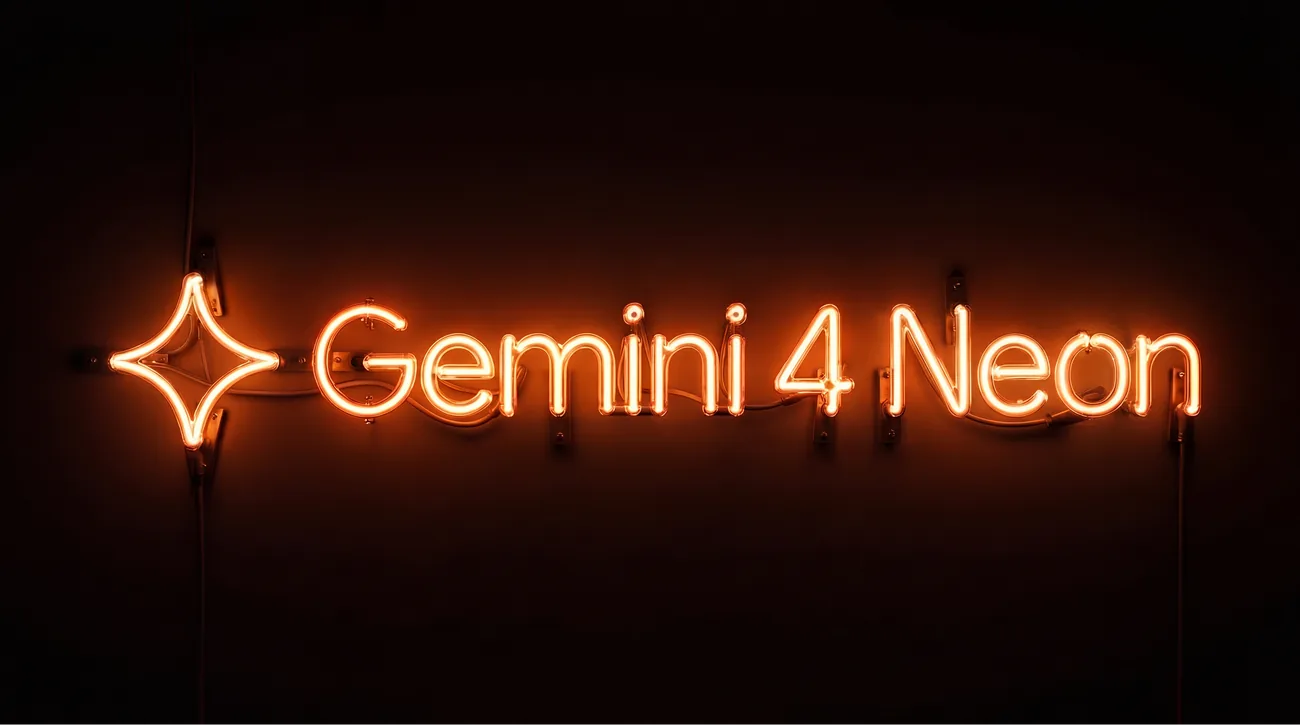
Evaluating Argon in late November requires placing it inside Google’s rapid four-model cadence across pricing and latency tiers. Gemini 4 Carbon (announced October 28 at $2/$10 introductory rates scaling to $4/$20, and opened broadly on November 10) anchors multi-day autonomous engineering and cyber defense; Gemini 4 Hydrogen (November 12) delivers fast $1.50/$7.50 agent loops; and Gemini 4 Neon (November 18, $3/$15) has already replaced Argon as the flagship default inside the consumer Gemini app.
Coding, competitive math, vision, and tool automation strengths
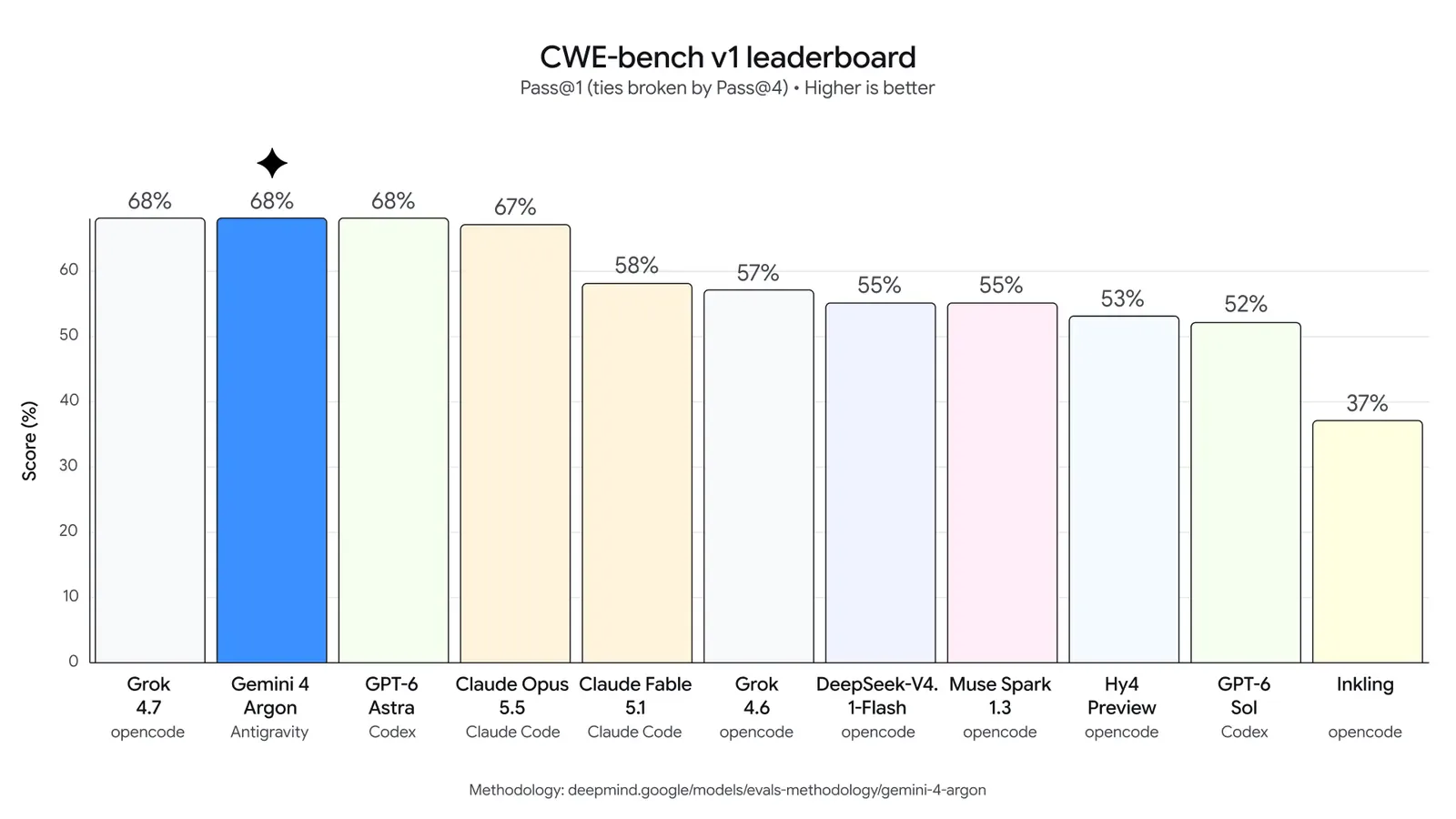
Gemini 4 Argon shines brightest in algorithmic programming, end-to-end app generation, and visual grounding. Alongside its #1 of 47 IOI ranking in Vals AI tracking, Argon posts 91.9% on Vibe Code Bench—a coding-assistance score corroborated by Vals AI in October 2026 and documented by Shattered.io. On multi-file DeepSWE v1.1 benchmarks, Shattered.io notes Argon edging ahead of Claude Opus 5.5 and GPT-6 Astra (77.9% vs. 74.2% and 74.1%), while Google’s September 30 CWE-bench v1 leaderboard shows Argon (Antigravity) tying Grok 4.7 and GPT-6 Astra for first at 68% ahead of Claude Opus 5.5 (67%) and DeepSeek-V4.1-Flash (55%).
However, even within software engineering, performance splits by evaluation harness: Argon posts 45.5 on the AA Coding Agents Index ($6.84/task) and 1,681±9 on LMArena WebDev Arena, yet trails GPT-6 Astra on FrontierSWE v2 and Claude Opus 5.5 on Terminal-Bench 4.0 by roughly 9 to 10.5 points (Shattered.io).
Scientific reasoning and multimodal workflow benchmarks round out Argon’s strengths. Roboflow’s independent evaluation records 85.1% mAP@50 on vision understanding alongside 57.6% on Terminal-Bench Science 0.1. Equally practical for enterprise builders, Artificial Analysis’s November 5 evaluation compiled by Emergent shows Argon beating Claude Opus 5.5 (Max effort) on AutomationBench-AA (78% vs. 70%), underscoring steady structured business-tool orchestration.
Where Argon stumbles: legal review, GUI agents, and hard repos
Closer inspection of both Google’s release tables and independent evaluations exposes sharp domain drops that buyers must audit before deploying Argon zero-shot. On the Harvey Legal Agent Benchmark, Argon achieves just 19.6% (Shattered.io)—ahead of GPT-6 Astra’s 5.4%, yet weak in absolute terms for autonomous contract or compliance work without strict retrieval guardrails. Similarly, on Coarena Computer Use evaluations, Argon places 5th of 19, solid enough for structured web flows yet trailing desktop-first GUI leaders.
Hard repository and PhD-level reasoning suites also separate Argon from peak Max-effort flagships. In November 5 Artificial Analysis measurements (Emergent), Argon (High effort) records 50 on the Intelligence Index v5.0.1 versus 59 for Claude Opus 5.5 (Max), trails sharply on FrontierCode 2.0 (26% vs. 46%), and scores 57% on HLE-Diamond versus 68% for Opus 5.5 (Max)—consistent with Shattered.io’s observation that Argon leads only one of four major comparative clusters head-to-head.
Latency and TTFT edge: 40.39s vs. Opus 5.5’s 342.98s wait
Where Gemini 4 Argon outperforms heavier reasoning competitors in daily developer ergonomics is Time to First Token (TTFT). In Artificial Analysis’s November 5 measurements (Emergent), Argon at High effort emitted its first token in 40.39 seconds while generating roughly 116,000 output tokens per task ($9.95/task at list rates, or $4.97/task across our November 19 v5.0.1 snapshot)—compared with 342.98 seconds (more than 5.5 minutes) and ~173,000 output tokens ($10.04/task) for Claude Opus 5.5 at Max effort.
Once streaming begins, Opus 5.5 prints faster (~110 tok/s vs. ~74 tok/s for Argon) and grants a wider 128K default output cap compared with Argon’s 65,536-token standard output limit. Note also that while Argon’s extended decoding API supports up to 1 million output tokens for massive C/C++ to Rust migrations or multi-document synthesis, deep output trajectories still multiply latency and token cost unless teams enforce automated test verification and early stopping checkpoints.
Multilingual leadership, Text Arena standing, and 1M multimodal input
Beyond English software tasks, BenchLM’s profile ranks Gemini 4 Argon #4 globally in Multilingual capability across 216 tracked models alongside its 79.1/100 overall composite. Human preference testing aligns well with that breadth: in LMArena’s November 18 snapshot, Gemini 4 Argon (High) holds 1,529±5 Elo on Text Arena—narrowly ahead of Claude Opus 5.5 High (1,514±6 Elo) at half the uncached token rate ($2/$10 vs. $4/$20).
Paired with its 85.1% mAP@50 Roboflow vision score and 1M-token input capacity, Argon handles mixed-language technical manuals, UI screenshots, PDF architecture specs, and repository bundles cleanly inside one context—though multi-step agent loops still benefit from explicit tool verification so intermediate errors do not compound.
Deployment surfaces also affect long-context workflow economics across Google’s stack. Calling Argon via Google DeepMind’s developer API and Vertex AI lets teams stack its 1-million-token input capacity with 95% prompt-caching discounts across static repository indexes, compliance playbooks, and repeated multi-turn agent system instructions. Although Gemini 4 Neon took over default routing inside the consumer Gemini app on November 18, keeping Argon pinned in API configs prevents sudden prompt drift wherever automated evals already match its output behavior.
Should you deploy Gemini 4 Argon, Carbon, Hydrogen, or Neon?
Keep Gemini 4 Argon in production if your pipelines already have calibrated evals on its High-effort API profile, prioritize AutomationBench-AA tool reliability (78%), or lean heavily on its #4 Multilingual ranking and Roboflow-verified visual precision inside 1M-token prompts.
For greenfield deployments in late November 2026, evaluate Gemini 4 Neon ($3/$15, 61 xhigh AA Index, #1 AA Coding Agent at 58.6) for balanced assistant and IDE workflows since Neon now anchors the Gemini app; choose Gemini 4 Hydrogen ($1.50/$7.50) for high-throughput subagents; and reserve Gemini 4 Carbon for Fairwind defensive cybersecurity and multi-day autonomous refactors.
Token budgets and output caps should anchor that final model routing table. Priced at $2.00 input / $10.00 output per million tokens, Gemini 4 Argon bridges Gemini 4 Hydrogen ($1.50/$7.50) for fast worker queues and Gemini 4 Neon ($3/$15) or Gemini 4 Carbon ($2/$10 introductory rates scaling to $4/$20) for peak autonomy. Because High-effort reasoning averages roughly 116K output tokens per complex evaluation task, enforcing explicit effort tiers and stop conditions keeps routine coding pipelines predictable.
Sources: Gemini 4 Argon Model Card|Google DeepMind ↗ Gemini 4 Argon Announcement & Cyber Evals|Google Blog ↗ Gemini 4 Argon on Vals Index & IOI|Vals AI ↗ Gemini 4 Argon Benchmark Profile|BenchLM ↗ Gemini 4 Argon Benchmark Breakdown (Vibe Code Bench, Roboflow, Harvey)|Shattered.io ↗ Claude Opus 5.5 vs. Gemini 4 Argon Benchmarks (Nov 5 AA Data)|Emergent ↗ Introducing Gemini 4 Neon|Google Blog ↗
THE BROADER CONTEXT · GOOGLE DOSSIER
Explore full product specifications, pricing analysis, and continuous coverage in the Google Desk Hub and Gemini Models Dossier. Independent benchmarks available on the AI Intelligence Index and Coding Agents Leaderboard.