Claude Code Background Agents: Why the 99% Cost Drop Only Saves 5% Per Session
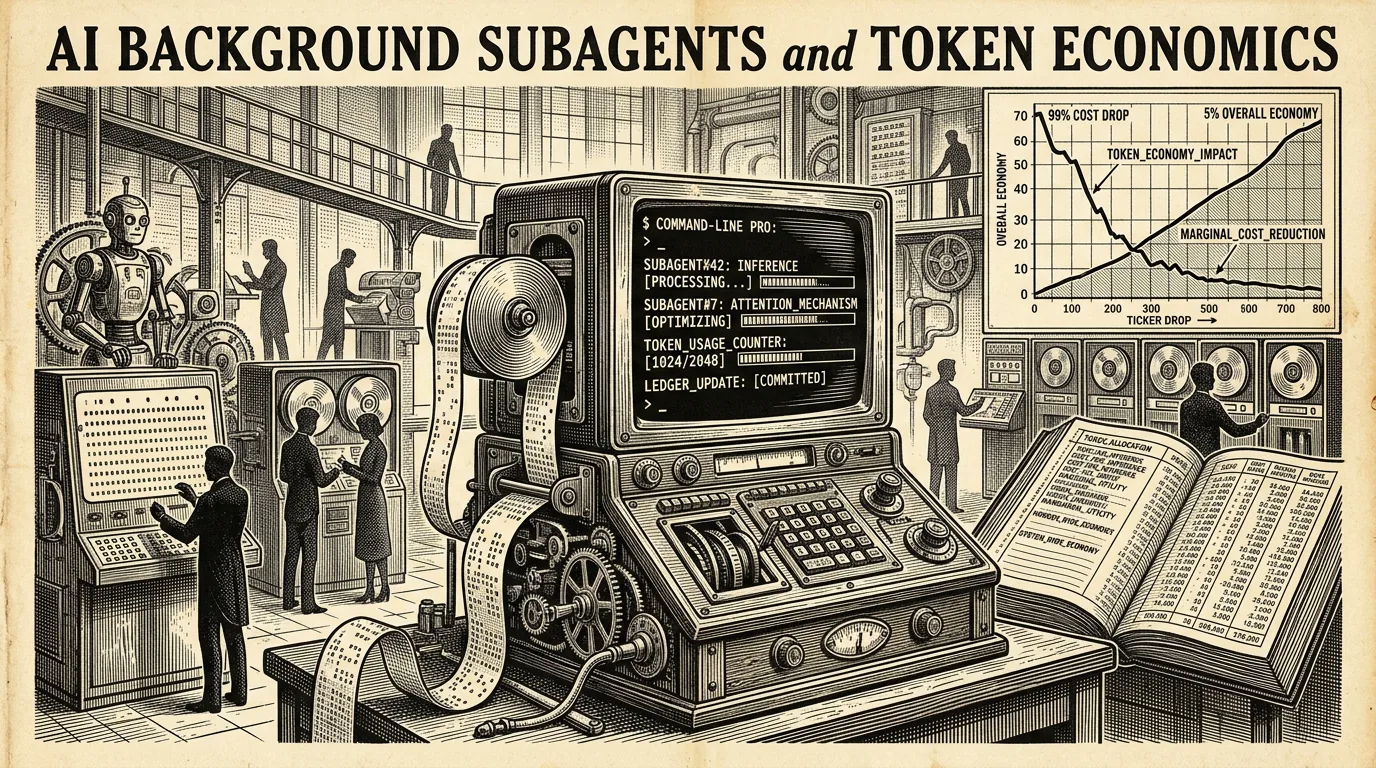
Anthropic’s headline 99% cost reduction applies strictly to 30-second progress summary calls, producing modest 5% whole-session token savings while subagents execute full models.
THE STORY IN THREE POINTS
- The 99% cost reduction touted in Claude Code v2.1.318 applies exclusively to periodic status-line updates, which now summarize progress without re-ingesting the full session transcript.
- Across a complete interactive session, eliminating transcript replays during background monitoring reduces overall token expenditure by roughly 5%, enabling ~6% more prompts per budget window.
- Developers can inspect the active path via claude --debug-file, checking whether [AgentSummary] shows characters of notes instead of forking full summaries, or disable it using environment variables.
Dissecting the 99% headline figure versus whole-session economics
Anthropic’s release notes for Claude Code v2.1.318 highlighted a dramatic "99% cost reduction" in background subagent monitoring. While the mathematical claim is technically accurate within its narrow scope, developer expectations of an order-of-magnitude cheaper development session require calibration against actual token consumption breakdown.
The 99% metric applies exclusively to the isolated progress summary queries dispatched every 30 seconds to update the terminal CLI’s status ticker. Previously, Claude Code re-fed the entire accumulated interaction history to generate each status line. By replacing full-history prompts with incremental delta summaries, the per-update cost plunged 99%. However, because actual code generation and bash execution continue to execute on full Claude 5.5 Sonnet weights, the total session cost decreases by only 4% to 6%.
Verifying subagent telemetry and inspecting debug outputs
Developers can verify whether their local installation leverages the optimized status mechanism by invoking the CLI with explicit logging: claude --debug-file debug.log. Inspecting the resulting trace reveals whether the [AgentSummary] subsystem reports "characters of notes" (indicating the new lightweight summary pipeline) or "Forking for summary" (indicating legacy full transcript evaluation).
For environments where background status polling introduces unwanted network traffic or interferes with strict token budgets, developers can disable progress summaries entirely by exporting CLAUDE_CODE_DISABLE_AGENT_PROGRESS_SUMMARIES=1 in their shell environment, preserving active subagent execution while silencing background pings.
Implications for rolling token pools and enterprise rate limits
While a 5% overall saving does not transform individual project economics, it provides tangible operational cushion for high-volume engineering organizations operating against Anthropic’s five-hour rolling usage windows and weekly shared seat pools.
By eliminating hundreds of redundant transcript re-evaluations during multi-hour debugging loops, developers effectively gain capacity for approximately 6% more active code generation prompts before encountering rate limit throttling, ensuring continuous developer velocity during intensive sprint cycles.
Sources: Claude Code Changelog & Subagent Progress Updates|Anthropic Documentation ↗ Claude Code v2.1.318 Release Notes & Architecture Guide|Anthropic GitHub ↗
THE BROADER CONTEXT · CLAUDE DOSSIER
Explore full product specifications, pricing analysis, and continuous coverage in the Claude Desk Hub. Independent benchmarks available on the AI Intelligence Index and Coding Agents Leaderboard.