Anthropic Outlines Claude’s Memory and "Dreaming": Why Autonomous Agents Must Consolidate Rather Than Accumulate
Anthropic detailed its approach to Claude’s memory on November 7, framing "dreaming" as offline consolidation that organizes learned knowledge and corrects errors rather than an autonomous learning mode or a new model release.
THE STORY IN THREE POINTS
- Anthropic presented Claude’s memory and "dreaming" on November 7 as an offline consolidation process that organizes learned information and corrects past errors so subsequent sessions find what they need more easily.
- The mechanism is not a new foundation model release, an always-on feature, or unconstrained autonomous learning; it operates between interactions as an analytical pruning and synthesis cycle.
- Why agents need memory consolidation: unconstrained memory dumps cause severe retrieval confusion, whereas disciplined note consolidation in game benchmarks boosted task success from 0.655 to 0.838.
An architectural mechanism, not a new model release or unbounded autonomous learning
On November 7, 2026, Anthropic detailed its perspective on Claude’s memory and "dreaming" via its official research channels (@AnthropicAI). The disclosure addressed widespread industry misunderstandings, clarifying that dreaming is neither a newly trained foundation model nor a commercial switch enabling unbounded, autonomous self-improvement in production.
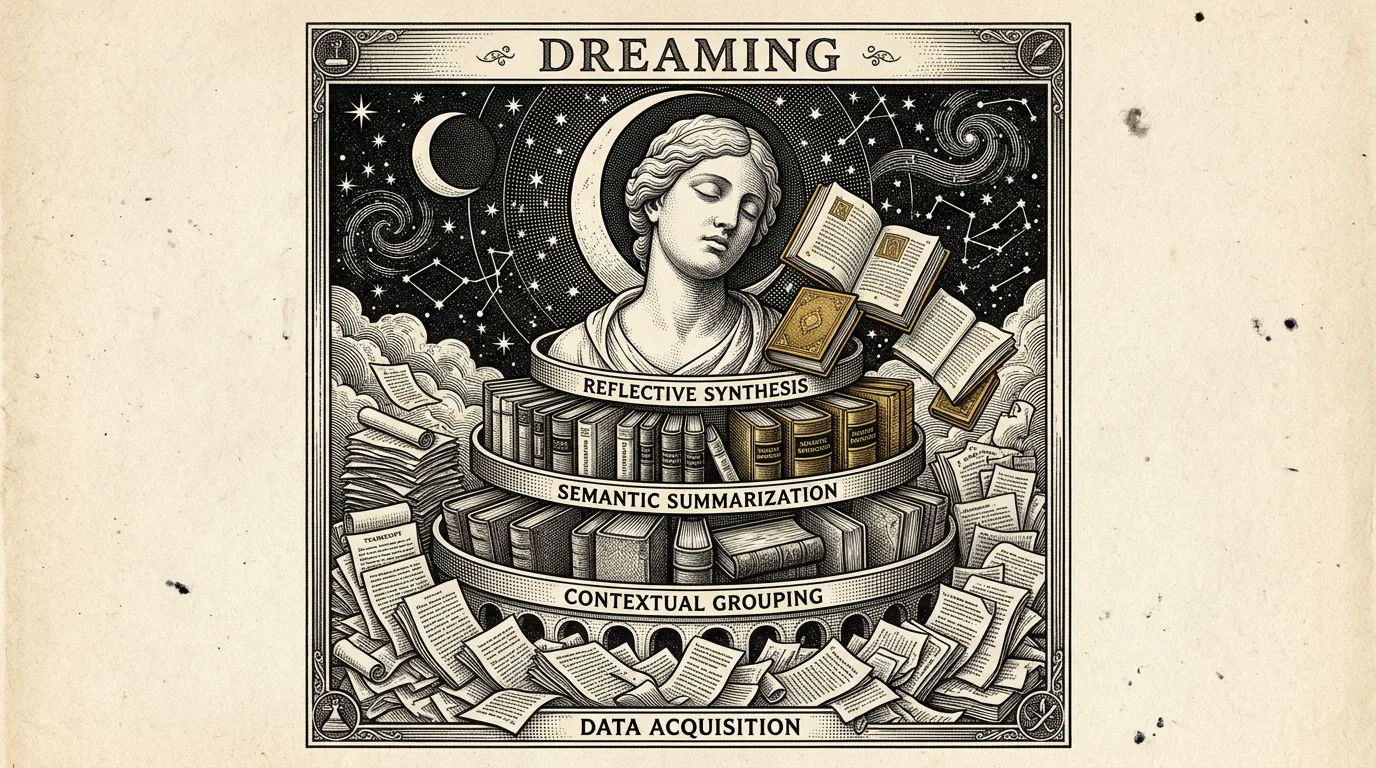
Instead, Anthropic frames dreaming as an offline consolidation phase inspired by human sleep cycles. Rather than continuously modifying neural network weights at runtime, the system analyzes accumulated session logs, extracts enduring procedural patterns, and rectifies recorded mistakes so that future prompts start with cleaner, verified context.
Why autonomous agents must organize memory rather than merely hoard it
A persistent trap in autonomous agent design is the assumption that larger context windows or infinite vector databases solve the long-term memory challenge. In practice, raw transcript dumps drown retrieval systems in transient noise, debugging chatter, and outdated assumptions.
Anthropic’s architecture divides agent memory into four operational tiers: raw interaction histories, editable scratchpad notes, synthesized domain knowledge, and injected prompt context. The dreaming cycle acts as an editor: inspecting prior attempts, resolving contradictions, purging dead ends, and organizing learned lessons into compact, indexed summaries that make subsequent problem-solving significantly faster.
Empirical validation: how compact notes outperform voluminous dumps
Experimental benchmarks across complex sandbox environments illustrated why memory pruning is essential. In long-horizon gaming evaluations running Pokémon Red, an agent permitted to unconstrainedly save notes generated 413 distinct memory files across 225 subdirectories but acquired only a single gym badge due to retrieval confusion.
Conversely, a constrained architecture operating on Fable 5 maintained only nine concise memory files alongside a centralized global summary, successfully earning four badges. On standardized CL-Bench evaluations, disciplined memory compaction improved task completion accuracy from a 0.655 baseline up to 0.838, proving that synthesis and deletion are far more critical to autonomous agents than sheer retention.
Sources: Anthropic (@AnthropicAI) agent memory and dreaming announcement|X ↗ Agent Memory Architecture & Sleep-Time Consolidation Research|Anthropic Research ↗ CL-Bench 1.0: Cross-Session Agent Memory Evaluation & Benchmarks|CL-Bench ↗
THE BROADER CONTEXT · CLAUDE DOSSIER
Explore full product specifications, pricing analysis, and continuous coverage in the Claude Desk Hub and Claude Models Dossier. Independent benchmarks available on the AI Intelligence Index and Coding Agents Leaderboard.