MiniMax M3.1 Flash weights arrive for multimodal agent work
Official weights are now downloadable. The 428B-parameter model pairs a million-token context with efficiency changes, while commercial use carries license conditions.
THE STORY IN THREE POINTS
- Official M3.1 Flash weights are available on Hugging Face, alongside existing hosted access.
- MiniMax lists about 428B total parameters, 23B active per token and a million-token context.
- API input/output rates remain $0.15/$0.60 per million tokens; self-hosting has separate infrastructure and license requirements.
Weights are available, updating the launch report
MiniMax’s October 19 announcement introduced M3.1 Flash through its API, M Plan and MiniMax Code, with weights promised later. That status has changed: checked on October 24, the official MiniMaxAI/MiniMax-M3.1-Flash repository contains downloadable model shards. This updates our October 20 report without assigning an unverified weight-release date.
A large MoE with efficiency changes
The model card describes a native multimodal mixture-of-experts model: text, images and video go in, and text comes out. Its advertised context reaches 1,000,000 tokens. MiniMax positions it for coding, agent workflows, computer use and cybersecurity.
Three changes build on M3: MiniMax Sparse Attention replaces the remaining early full-attention layers; quantization-aware training reduces memory and serving demands; and DSpark replaces the previous speculative-decoding approach. The release includes a DSpark draft head. These are MiniMax’s architectural descriptions, rather than independently measured deployment savings.
Deployment depends on the serving stack
The model card provides an hf download command and points to SGLang, vLLM and TokenSpeed deployment recipes. Local sampling recommendations are temperature=1.0 and top_p=0.95; reasoning_effort can be passed through the chat template from low through max.
Follow the current framework recipe and supported revision. The SGLang cookbook currently says M3.1 support has not merged into main and shows an unresolved support-PR placeholder. The vLLM recipe includes multi-GPU configurations with different context limits; TokenSpeed documents a Blackwell requirement for its mixed-precision path. Availability of weights therefore does not establish that a generic installation will run the full advertised window.
The Hugging Face interface separately displays 220B in its Safetensors summary. That differs from the model card’s parameter description; the available sources do not explain the discrepancy, so we do not infer a cause.
Hosted API controls are a separate contract
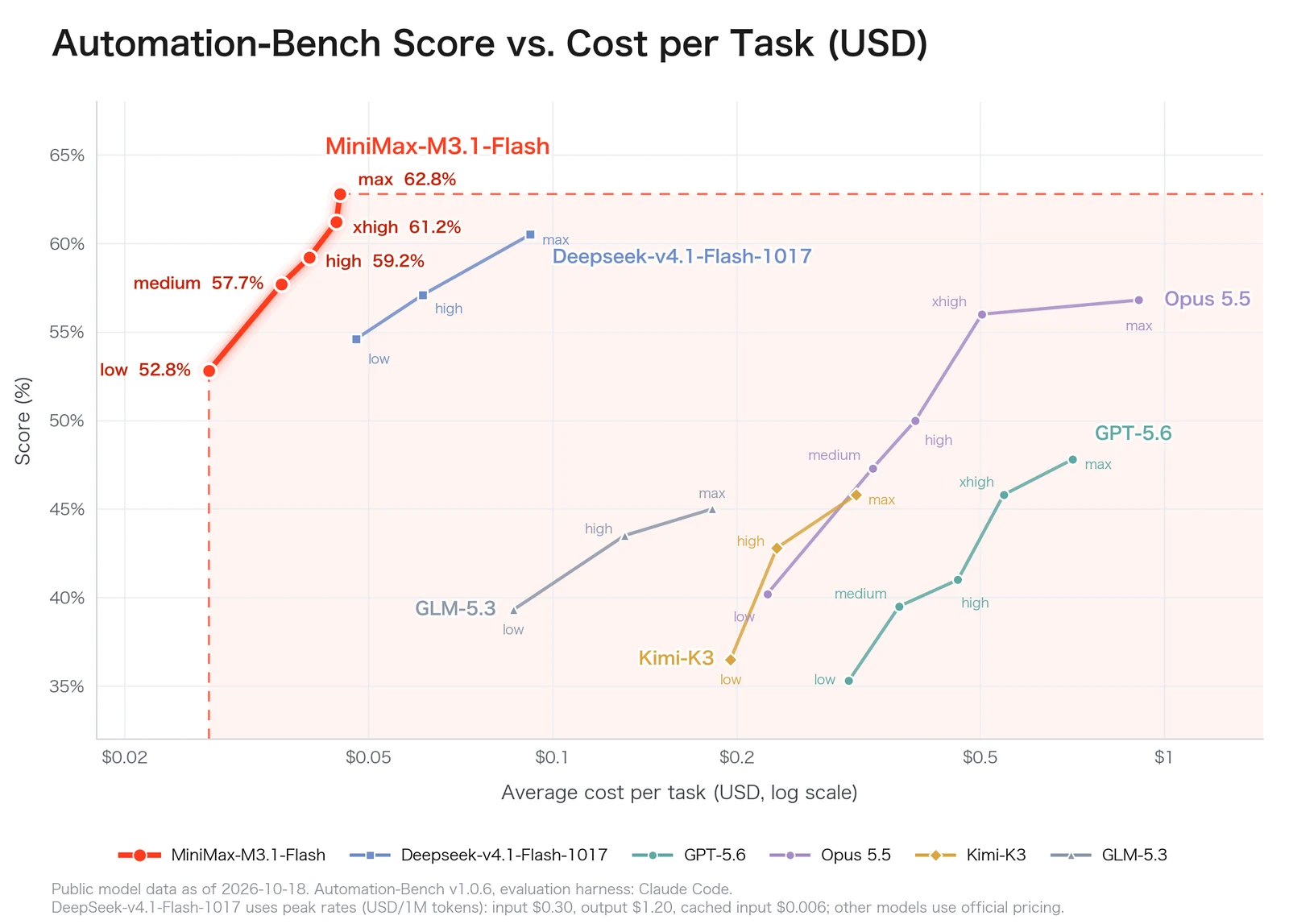
MiniMax’s Anthropic-compatible hosted endpoint accepts output_config.effort values low, medium, high, xhigh and max, defaulting to max. It requires thinking for M3.1 Flash. Higher effort can add reasoning tokens and latency, and those tokens consume the generation limit.
Unlike local sampling guidance, this endpoint ignores supplied temperature and top_p values, using 1 and 0.95 respectively. Tool integrations should retain the complete assistant response, including thinking and tool-use blocks, in later turns. Check the interface actually being used before transferring settings between hosted and self-hosted deployments.
What the published results show
The launch reports 73.7% on DeepSWE v1.1, 61.7 on OSWorld V2 and 29.6 on Agents’ Last Exam. MiniMax also claims nearly threefold faster online inference and roughly 70% lower agent usage costs than its predecessor. These are supplier-reported comparisons; this publication has not reproduced them, and results depend on workload and evaluation setup.
What the API costs
The official rate card remains $0.15 per million input tokens, $0.60 per million output tokens and $0.015 per million cached-input tokens. One million uncached input tokens plus one million output tokens totals $0.75 across requests. That calculation describes token usage, not a completed agent task or an M Plan subscription.
Downloaded weights move the cost calculation to infrastructure, operation and utilization. A low hosted token rate alone cannot establish whether renting GPUs or operating a deployment will be cheaper for a particular workload.
Commercial use has explicit conditions
The repository uses the MiniMax Community License. It grants free noncommercial use, subject to conditions including preservation of notices. For commercial products or services, it requires prominent “Built with MiniMax M3.1-Flash” attribution and a one-time notice to MiniMax. If those products or services generate more than US$20 million in yearly revenue, prior written authorization is required instead.
The appendix also prohibits military purposes and specified harmful uses. Downloadable weights should therefore be described with their license conditions attached. Teams considering redistribution, fine-tuning or a commercial service should read the full repository license for their intended use.
Editorial context: compare finished tasks
The practical comparison is a finished, reviewed task. Test the same repository, instructions and tools, and record completion rate, elapsed time, total usage and reviewer effort across repeated runs. For a self-hosted trial, record the framework revision, hardware and context configuration as well. This separates model capability from serving choices and makes the efficiency claims testable against a team’s own work.
Sources: MiniMax: M3.1 Flash — Redefining Agent Performance and Cost ↗ MiniMax: official M3.1 Flash model card and inference settings ↗ MiniMax: official downloadable model files ↗ MiniMax Community License: commercial conditions and prohibited uses ↗ SGLang: MiniMax M3.1 deployment cookbook ↗ vLLM: MiniMax M3.1 Flash deployment recipe ↗ TokenSpeed: model deployment recipes ↗ MiniMax API Docs: Anthropic SDK compatibility and thinking controls ↗ MiniMax API Docs: Pricing overview ↗