Kimi K3.1 Pro arrives with 1M context; weights promised by November 4
Moonshot’s new flagship and Highspeed variant are available through its products and API. The downloadable-weight release is still ahead.

THE STORY IN THREE POINTS
- The 3T-class flagship supports a 1,048,576-token API context and a faster Highspeed variant.
- Moonshot plans to release the full weights by November 4, 2026.
- Standard API rates are $2 input and $10 output per million tokens, with separate cache billing.
Hosted access now, downloadable weights later
Kimi K3.1 Pro and Highspeed are rolling out across Kimi’s web and mobile apps, Work, Code and API. Enterprise access requires administrator enablement.
The company says full weights will follow by November 4, 2026. As checked on October 24, this remains a planned release. Teams considering deployment on their own infrastructure still need the actual files and applicable license before making that decision.
A 3T-class model with a million-token window
The API pricing documentation specifies a 1,048,576-token context for K3-series models. Artificial Analysis describes K3.1 Pro as having roughly 2.8 trillion total parameters, with 104 billion active, and text and image inputs. Total and active parameter counts describe different aspects of a mixture-of-experts model; neither alone determines deployment memory or task quality.
Moonshot describes additional K3 post-training with joint reinforcement learning across hundreds of domains. It advertises Highspeed at two to three times standard speed. This vendor comparison does not guarantee throughput for every workload.
Keep the official and independent evaluations separate
Moonshot reports 65.7% on Terminal-Bench 4.0, 61.2% on its internal Kimi Code Bench 3.0 Long-horizon, 92.7% with tools on BenchCAD and 64.4 on OfficeQA Pro v2. Its internal Hallu Bench Hard claim-level error rate falls from K3’s 23.4% to 8.3%; this deliberately difficult test does not measure everyday error rates.
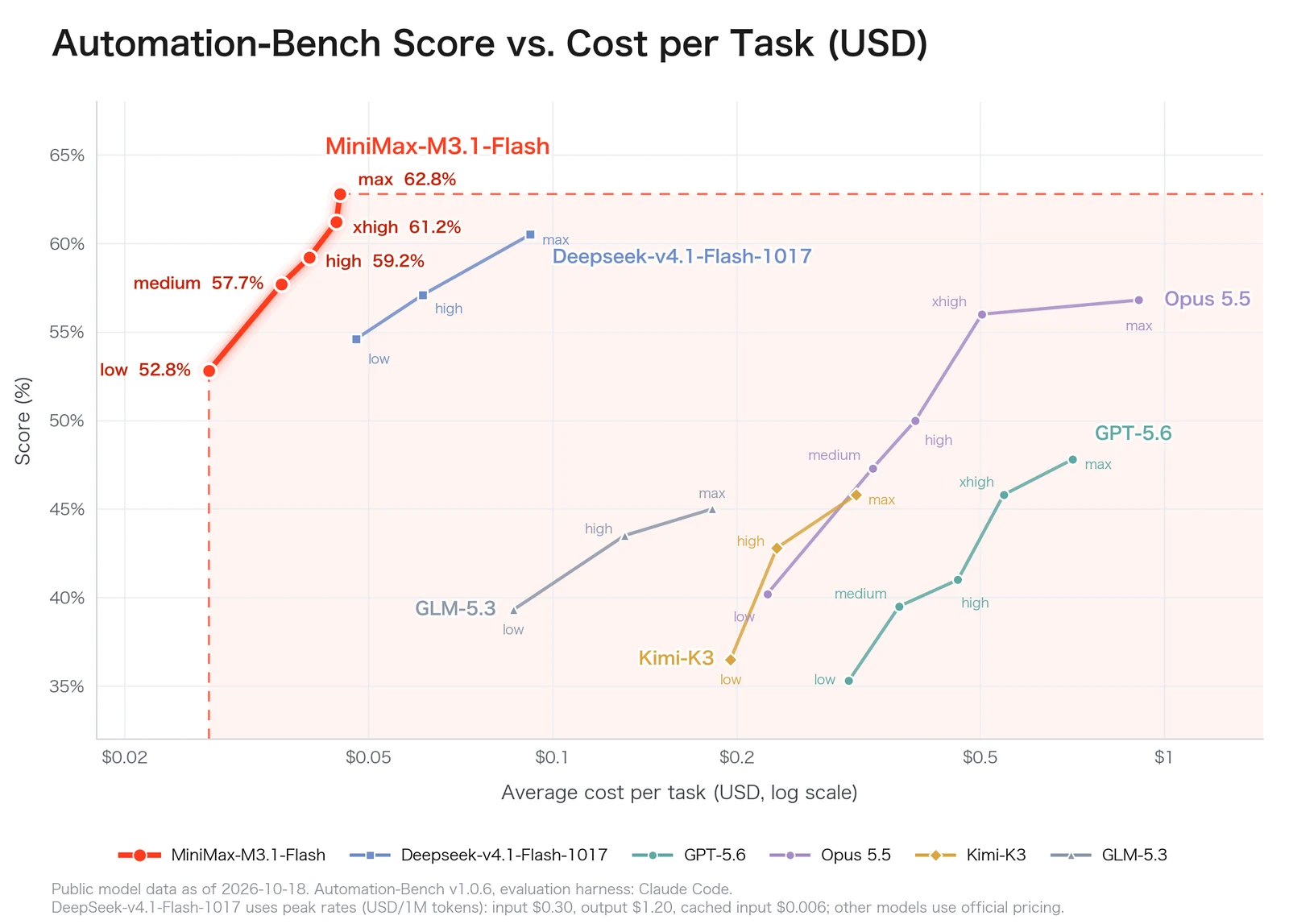
Artificial Analysis’s October 23 launch analysis gives K3.1 Pro an Intelligence Index score of 55, up from K3’s 44, placing it fourth in that dated comparison. It reports 1,846 Elo on GDPval-AA, 73% on AutomationBench-AA and 67% on Terminal-Bench 4.0. The latter is a separate reported evaluation from Moonshot’s 65.7%; this article does not treat the two numbers as interchangeable.
AA says the model would lead its open-weight comparison once the weights are released. That conclusion was conditional on a future release and the leaderboard at the time. It does not establish that weights are already public, or promise a permanent ranking.
Lower standard rates, a higher-priced speed option
The international API platform lists kimi-k3.1-pro at $2 per million input tokens, $10 per million output tokens and $0.20 per million cache-hit tokens. The corresponding Highspeed rates are $4, $20 and $0.20. Standard input, output and cache-hit rates are about one-third below the platform’s listed K3 prices.
Cache writes are an additional billing item, with separate five-minute and one-hour retention tiers. Repeated prefixes are cached automatically; a hit uses the cache-hit rate without a further write charge. The guide describes flat token pricing across context lengths. A lower token rate still does not guarantee a cheaper completed task: generated tokens, retries and cache behavior affect the bill.
The API and Kimi Code have different access rules
The API quickstart says the flagship unlocks after a successful top-up of at least $1. Its OpenAI-compatible model IDs are kimi-k3.1-pro and kimi-k3.1-pro-highspeed. Thinking stays enabled, with low, high and max reasoning effort; max is the default. For tool use and continued conversations, applications should preserve the complete returned assistant message.
Kimi Code has separate subscription requirements. Its documentation puts K3.1 Pro on Plus / Moderato and above, with that tier limited to 256K context. Pro / Allegretto and above unlock up to 1M and the Highspeed variant. Kimi Code credentials and the Open Platform’s API keys are separate, so product availability does not mean every account receives the full window.
What to evaluate before the weight release
Editorial context: hosted access provides a way to compare quality, end-to-end latency and completed-task cost before planning a local deployment. Use representative repositories and documents, record the reasoning setting and include unsuccessful runs. A large context window is capacity for evidence, rather than proof that every answer uses it accurately.
Moonshot says it filtered cybersecurity training data for the planned weight release while retaining general coding material. The eventual release files and license will be the practical next checkpoints for teams considering self-hosting.
Sources: Moonshot AI: Kimi K3.1 Pro technical announcement ↗ Kimi API: international model prices ↗ Kimi API: billing and context-window details ↗ Kimi API: K3.1 Pro quickstart and integration limits ↗ Kimi Code: subscription and context access requirements ↗ Artificial Analysis: dated launch evaluation, October 23 ↗